Can I really check my 90-year-old grandmother's breathing at night from my phone?
Can you monitor an elderly loved one's breathing at night from your phone? A research look at contactless elderly vital signs at home and what the data shows.
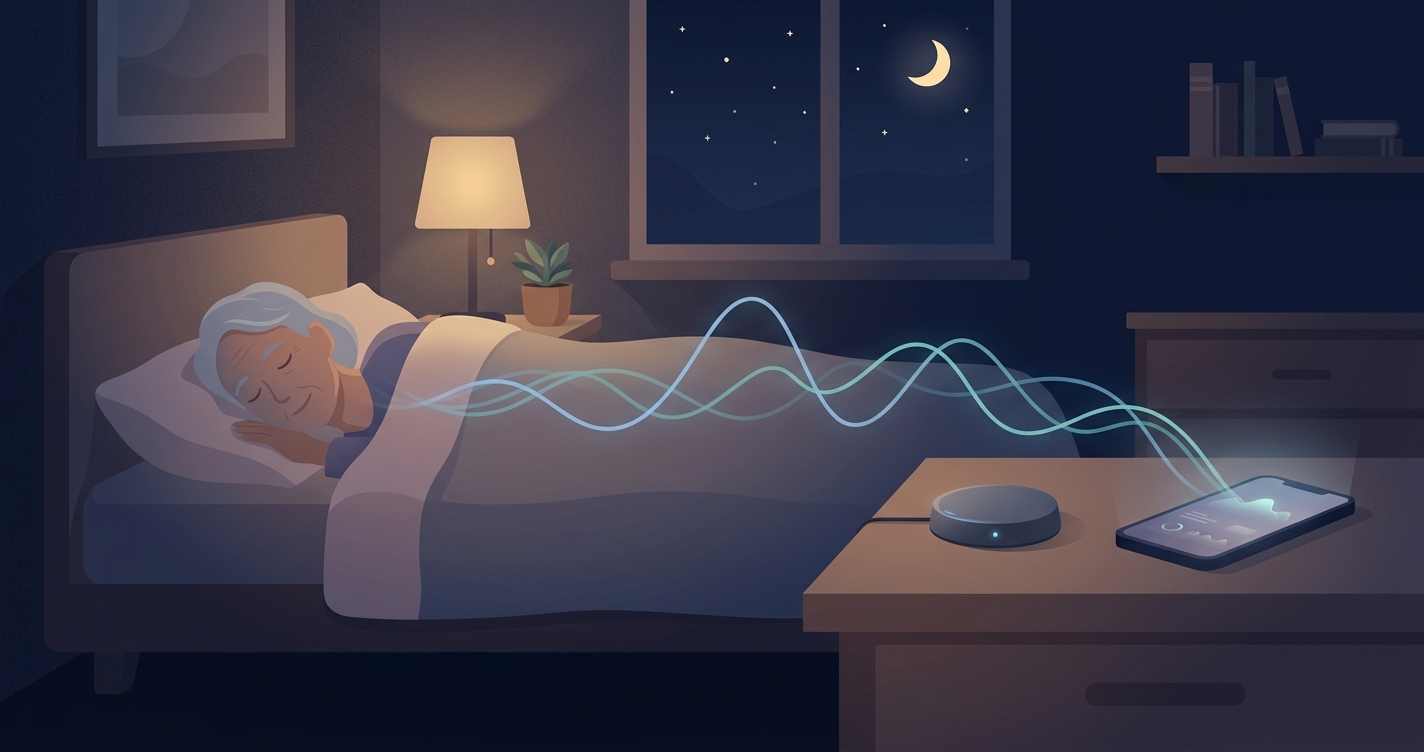
If you have ever stood in a darkened bedroom doorway at 2 a.m., watching for the rise and fall of an elderly relative's chest, you already understand the specific fear behind this question. For families caring for someone in their late eighties or nineties, breathing during sleep becomes a quiet obsession. The good news is that the technology to track elderly vital signs at home, including breathing rate overnight, has moved from hospital sleep labs into ordinary bedrooms. The harder truth is that not every product marketed to nervous families measures what it claims, and the phone in your hand is a window into the data rather than the sensor itself.
A 2023 digital health evaluation study of community-dwelling adults aged 65 to 83 found that contactless devices estimated overnight breathing rate with a mean absolute error of 1.6 breaths per minute or less compared against clinical polysomnography. - JMIR mHealth and uHealth, 2023
What "checking breathing from your phone" actually means for elderly vital signs at home
Your phone does not measure breathing. A sensor in the room does, and your phone displays the result. This distinction matters because the quality of what you see at 2 a.m. depends entirely on the sensor sitting near the bed, not the app. When families ask whether they can check a 90-year-old grandmother's breathing remotely, they are really asking three separate questions: can a device detect her breaths accurately, can it do so without disturbing her, and can the information reach a phone in another room or another state.
Several sensing approaches now address elderly vital signs at home without asking a frail older adult to wear, charge, or press anything. Researchers studying older populations have repeatedly noted that contactless methods are valuable precisely because they are, in the language of one 2023 evaluation, "unintrusive and burdenless." A 90-year-old with arthritis, thin skin, or cognitive changes is the worst possible candidate for a wristband that needs nightly charging and a button she must remember to press.
The main categories of overnight breathing monitoring break down as follows.
| Approach | How it senses breathing | Contact required | Best fit for a 90-year-old |
|---|---|---|---|
| Camera / optical | Detects subtle chest and body movement, sometimes skin color change | None | Strong, if lighting and placement are managed |
| Bedside radar | Emits radio waves, reads chest wall displacement | None | Strong, works in full darkness |
| Under-mattress strip | Senses movement and ballistic force through the mattress | None (placed under bedding) | Strong, fully hidden |
| Wearable band or watch | Motion and optical sensors on the body | Yes, worn on wrist or chest | Weak, requires charging and compliance |
| Manual counting | A person counts breaths for 60 seconds | Presence required | Impractical for overnight, every night |
The pattern is clear. For the oldest and frailest adults, the approaches that require nothing on the body tend to win on real-world usability, even when a wearable might match them on raw accuracy in a controlled test.
Why breathing rate is worth watching at all
Some families assume breathing is only worth checking for sleep apnea. The research community sees respiratory rate as something more fundamental. It is often the earliest vital sign to change when an older adult's condition is deteriorating.
- Respiratory rate frequently shifts before heart rate or blood pressure when illness sets in, which is why it anchors clinical early warning scores such as NEWS2.
- A sustained rate above roughly 25 breaths per minute is treated as a warning sign in many clinical settings, though normal ranges drift upward with age.
- Continuous overnight measurement catches sustained abnormalities that a single daytime count would miss entirely.
- Conditions that breathing changes can flag early include respiratory infections, heart problems, sepsis, and exacerbations of chronic lung disease.
For a 90-year-old, where a chest infection can escalate from "a little tired" to a hospital admission within a day or two, an overnight trend showing a creeping respiratory rate is genuinely useful information to bring to a clinician.
Industry Applications
Family caregivers at a distance
The most common scenario is an adult child or grandchild who does not live in the home. Contactless overnight monitoring lets that person open an app in the morning and see whether their grandmother slept, what her average breathing rate was, and whether anything fell outside her normal pattern. It replaces the anxious midnight phone call with a calm morning glance. Importantly, the value is in the trend over days and weeks, not in staring at a live number all night.
Home health agencies
Agencies increasingly layer passive monitoring on top of scheduled visits. A nurse who visits twice a week gains continuous context for the five days she is not present. Overnight respiratory data can help an agency decide whether a patient needs an earlier visit, supporting the broader push to keep older adults out of the emergency department.
Senior living and PACE programs
In congregate settings and Programs of All-Inclusive Care for the Elderly, staff cannot sit at every bedside. Room-based sensing scales overnight observation across many residents at once, surfacing the handful whose breathing or sleep changed enough to warrant a closer look.
Current research and evidence
The evidence base for contactless breathing measurement in older adults has matured considerably. A 2023 study published in JMIR mHealth and uHealth evaluated three contactless technologies, two under-mattress trackers and one bedside radar unit, in 35 community-dwelling adults aged 65 to 83. Data was collected both in a sleep laboratory and at home, with results compared against polysomnography, the clinical reference standard. All three contactless systems estimated breathing rate with a mean absolute error of 1.6 breaths per minute or less and a mean absolute percentage error under 12 percent at one-minute resolution.
Radar-based work has reported even tighter agreement in some setups. Published validation of contactless radar devices has shown agreement with reference methods such as capnography and thoracic effort belts, with whole-night breathing rate errors well under 1 breath per minute in favorable conditions. Researchers consistently flag one caveat: motion artifacts. When a person moves, coughs, or a second body shares the bed, accuracy drops, and devices typically report a gap rather than a wrong number during those periods.
On the clinical importance side, a long line of work supports watching respiratory rate in older adults. A frequently cited paper on raised respiratory rate in elderly patients describes it as a valuable and underused physical sign, and a scoping review on respiratory rate as a predictor of clinical deterioration and mortality found consistent associations between abnormal rates and worse outcomes. Separately, research has documented that normal resting respiratory rate tends to rise with age, which is why "normal" should be defined per person rather than against a single textbook number.
The honest summary: the science supports that breathing can be measured accurately overnight without contact, and that the measurement is clinically meaningful. The science does not support treating any consumer alert as a diagnosis. These tools surface patterns; clinicians interpret them.
The Future of contactless elderly vital signs at home
Three shifts are likely over the next few years. First, multi-signal fusion will become standard, with breathing rate combined with heart rate, movement, and sleep staging so that a single anomaly is weighed against the full picture rather than triggering a false alarm. Second, personalization will improve, as systems learn each individual's baseline and flag deviations from her own normal instead of a population average, which matters enormously for someone whose resting rate at 90 differs from a textbook 60-year-old. Third, integration with care teams will deepen, so that a meaningful overnight change reaches a home health nurse or PACE clinician through a shared record rather than sitting unread in a family member's app.
The direction of travel favors exactly the population that needs it most: the very old, who benefit most from being watched and tolerate intrusive devices least.
Frequently asked questions
Can I really see my grandmother's breathing in real time on my phone? You can see her breathing rate and overnight trends through an app, but the measurement is done by a sensor in her room, not by your phone. Most families find the morning summary and trend over time more useful than watching a live number all night, which tends to fuel anxiety rather than ease it.
Is contactless breathing monitoring accurate enough to trust for a 90-year-old? Peer-reviewed studies in older adults report breathing rate errors of roughly 1.6 breaths per minute or less against clinical reference standards. That is accurate enough to spot meaningful trends and changes. It is not a substitute for a clinical assessment, and accuracy can drop during movement or when two people share a bed.
Will she have to wear or charge anything? With camera, radar, or under-mattress approaches, no. That is the central advantage for very elderly or cognitively impaired adults who cannot reliably manage a wearable. The sensor sits in the room and works passively.
What should I do if I see an abnormal reading? Look at the trend rather than a single data point, note any other symptoms, and contact her clinician or home health team. These tools are designed to prompt a timely conversation with a professional, not to replace one.
Circadify is building toward this exact need: non-intrusive overnight and daily health checks for the oldest adults, with no wearables and no buttons, so families and home health teams can share the same picture of how a loved one is doing. If you are a family caregiver or run a senior care program and want continuous peace of mind without burdening the person you are caring for, explore how a senior care program built around contactless monitoring can fit your situation.