Can I really check my 85-year-old mom's heart rate without special gadgets?
A research-based look at how families monitor elderly vital signs at home using non-intrusive camera technology, no wearables or buttons required.
If you have ever pressed your fingers to your mother's wrist and tried to count beats while she pulled away or fidgeted, you already know the core problem with home heart monitoring. The question of whether you can track an 85-year-old parent's heart rate without buying a chest strap, a finger clip, or a smartwatch she will refuse to wear is no longer wishful thinking. Checking elderly vital signs at home has quietly moved from manual counting and clip-on devices toward camera-based methods that read the body without touching it. For the millions of adult children managing care from down the hall or across the country, that shift changes what daily oversight can look like.
"77% of adults aged 50 and older want to remain in their homes for the long term, yet nearly half of family caregivers worry about whether their loved one can keep living independently.", AARP 2021 Home and Community Preferences Survey
How you can track elderly vital signs at home without wearables
The technology making this possible is called remote photoplethysmography, usually shortened to rPPG. The idea is simpler than the name. Every time the heart beats, it pushes a pulse of blood into the tiny vessels just under the skin of the face. That pulse causes microscopic color changes in the skin that the human eye cannot see, but a standard camera can. Software isolates those changes from the video signal and reconstructs the pulse waveform, then calculates heart rate from it.
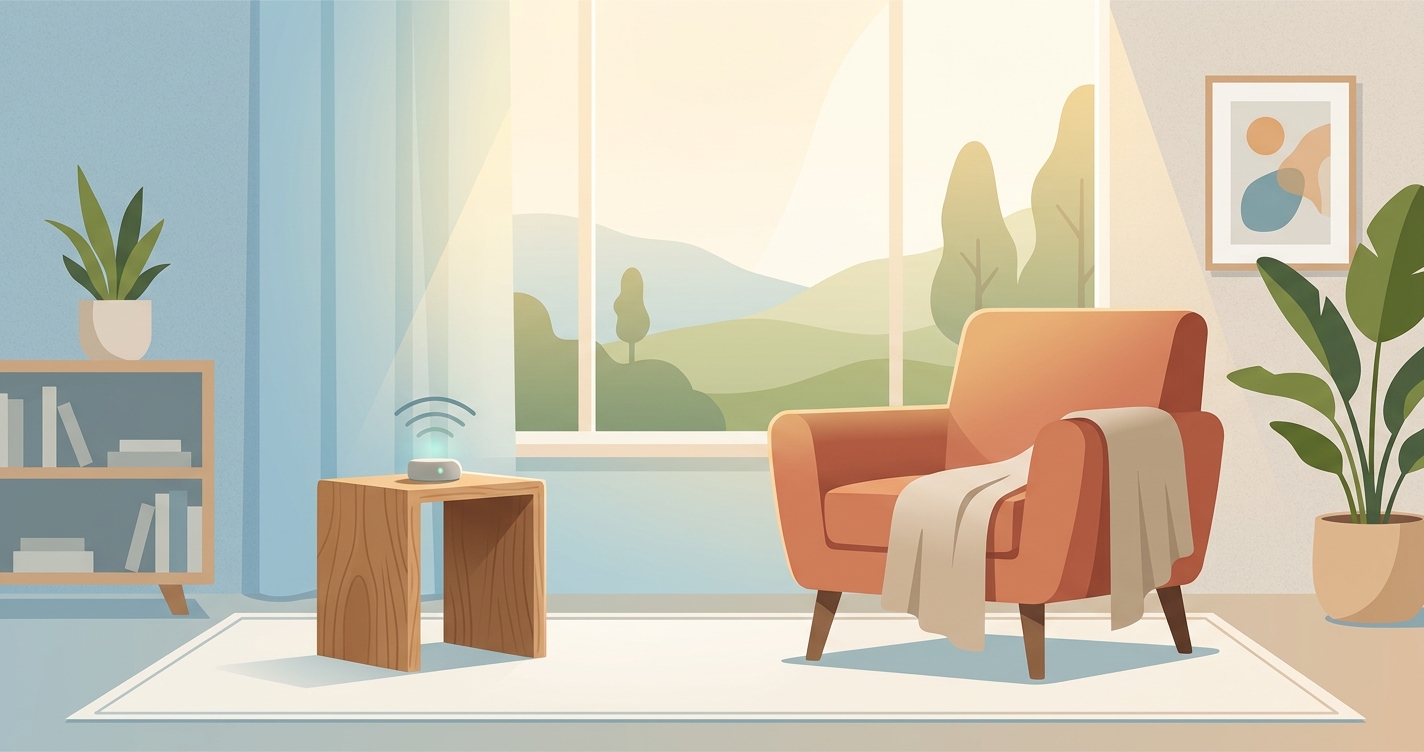
In practice this means your mother does not have to wear, hold, charge, or remember anything. A camera positioned where she already spends time, such as near a favorite chair, captures the data passively while she watches television or reads. There is no button to press, no cuff to fasten, and no wristband to lose. For a parent who is forgetful, arthritic, or simply tired of being treated like a patient, the absence of a device is the whole point.
This matters because adherence is where most home monitoring plans fall apart. A device only helps if it is worn, and the data shows the gap is real. The 2021 AARP survey found one in five Americans is now a family caregiver, and the average out-of-pocket cost of caregiving reached $7,242 that year. Spending money on a gadget that ends up in a drawer is a familiar frustration.
What "no special gadgets" actually means
To be precise, you do still need a camera and software. What you do not need is anything attached to your mother's body. The distinction matters when you are weighing options.
- No wearables means nothing on the wrist, chest, or finger.
- No active participation means she does not start a reading or hold still on command.
- No charging or maintenance means there is no daily habit for her to forget.
- No stigma means the setup looks like part of the room, not a hospital.
Comparing common ways to check a senior's heart rate at home
Families generally choose among four approaches. Each has trade-offs in accuracy, daily burden, and how willing an older parent is to use it consistently.
| Method | What it requires from your parent | Daily effort | Works for resistant or forgetful seniors | Captures trends over time |
|---|---|---|---|---|
| Manual pulse check | Sit still while you count | High, needs another person | Poor, depends on a visitor | Rarely, sporadic readings |
| Finger pulse oximeter | Place and hold the clip | Medium, must remember | Moderate, needs cooperation | Only if logged manually |
| Wearable smartwatch | Wear and charge daily | Medium to high | Poor, often removed | Yes, if worn consistently |
| Contactless camera (rPPG) | Be in view of the camera | Very low, passive | Strong, nothing to do | Yes, automatic daily logs |
The pattern is clear. The methods that produce the richest trend data are usually the ones that demand the most cooperation, which is exactly what an 85-year-old is least likely to provide day after day. Contactless camera monitoring is the one approach that scores well on both consistency and low burden.
What the research says about camera-based heart rate
The reasonable next question is whether a camera reading can be trusted. The peer-reviewed evidence has matured considerably.
A 2023 clinical validation study of rPPG software in cardiovascular disease patients, published in the journal Sensors (MDPI), tested the method against electrocardiography, the clinical gold standard, in 47 patients. The camera-derived pulse rate showed a mean absolute error of about 1.06 beats per minute and a Pearson correlation of 0.962 with ECG. A separate pilot validation study using facial video, published in a peer-reviewed setting, reported mean absolute errors between 0.1 and 0.4 bpm across different averaging windows on healthy volunteers.
Researchers at Google have also published work on passive heart rate measurement from a standard camera, reporting mean absolute percentage errors below 10% across all skin tone groups, including in free-living rather than laboratory conditions. That last point matters for older adults at home, where lighting and movement are never perfectly controlled.
The research community is honest about the limits. A widely cited finding is that rPPG accuracy can drop at elevated heart rates, and performance suffers with poor lighting, heavy motion, occlusion of the face, and image degradation. Skin tone diversity has historically been a weak spot, though newer models have narrowed that gap. The honest summary for a family caregiver is this: for resting heart rate trends in a seated senior at home, the technology is well supported, while precise readings during exertion or distress remain harder.
Industry applications beyond the family living room
The same approach families are now considering at home is already being deployed by professional care providers, which is part of why it has matured so quickly.
Home health and PACE programs
Home health agencies and Programs of All-Inclusive Care for the Elderly use contactless vitals to extend oversight between in-person visits. A nurse cannot be present daily, but a camera can flag a heart rate trending upward over a week, prompting a call before a small change becomes an emergency department visit.
Senior living and memory care
In assisted living and memory care, residents often cannot reliably participate in their own monitoring. Passive measurement removes the cooperation requirement entirely, which is why operators have adopted it for populations with cognitive decline.
Distance caregiving
For the adult child living in another state, the application is the most personal. Daily heart rate and other vital sign trends, viewable from a phone, replace the guesswork of a once-a-week phone call where a parent insists everything is fine.
Current research and evidence
The direction of the literature since the pandemic has been toward integrating rPPG into continuous remote monitoring using low-cost cameras, especially for people managing chronic conditions like heart failure. Review articles, including a comprehensive 2023 survey of rPPG and deep learning methods published in peer-reviewed journals, document steady improvement in handling real-world noise. The combination of better algorithms and ordinary hardware is what moved this from a laboratory curiosity to something practical for a home.
What the evidence does not support is treating a camera reading as a diagnostic substitute for clinical equipment. The strongest use case is longitudinal trend detection, watching how a baseline shifts over days and weeks, rather than chasing a single perfect number. For caregivers, a rising resting heart rate over several days is often more actionable than any one measurement.
The future of elderly vital signs at home
The trajectory points toward measuring more than heart rate from the same passive video. Research is actively extending camera-based methods to respiration rate, and work continues on blood pressure estimation and signs of atrial fibrillation, though those remain less mature. As models improve at handling diverse skin tones and imperfect home lighting, the gap between a clinical reading and a living-room reading should keep narrowing. The likely outcome is a home environment that quietly understands a senior's baseline and surfaces meaningful change, without ever asking the senior to do anything at all.
Frequently asked questions
Can a regular camera really measure my mom's heart rate accurately? For resting heart rate in a seated person, peer-reviewed validation studies have shown camera-based readings agreeing closely with ECG, with errors around 1 bpm in some clinical tests. Accuracy is lower during heavy movement or at very high heart rates, so the technology is best used for tracking resting trends rather than exertion.
Does my mother have to do anything for it to work? No. The defining feature of contactless monitoring is that it is passive. As long as she is within view of the camera while sitting or relaxing, the system captures readings without any button, wearable, or active participation on her part.
Is this a replacement for her doctor or clinical equipment? No. Camera-based monitoring is designed to track daily trends and flag changes worth a closer look, not to diagnose conditions. It complements clinical care by giving you and her providers more frequent data between visits.
What if she has darker skin or the room is dimly lit? Older rPPG systems struggled with darker skin tones and poor lighting, but newer models have reduced those gaps, with some research reporting consistent accuracy across skin tone groups. Reasonable, steady room lighting still produces the most reliable readings.
Circadify is building toward exactly this kind of non-intrusive daily oversight, turning an ordinary camera into a quiet check on an aging parent's well-being. If you are weighing how to keep watch over your mother's health without asking her to wear or do anything, you can explore how a senior care monitoring program approaches remote health oversight for families and providers.