Can my elderly mother's sleep patterns tell us something important about her health?
How sleep data reveals deeper health insights for seniors, and why elderly vital signs at home during the night are a window into hidden change.
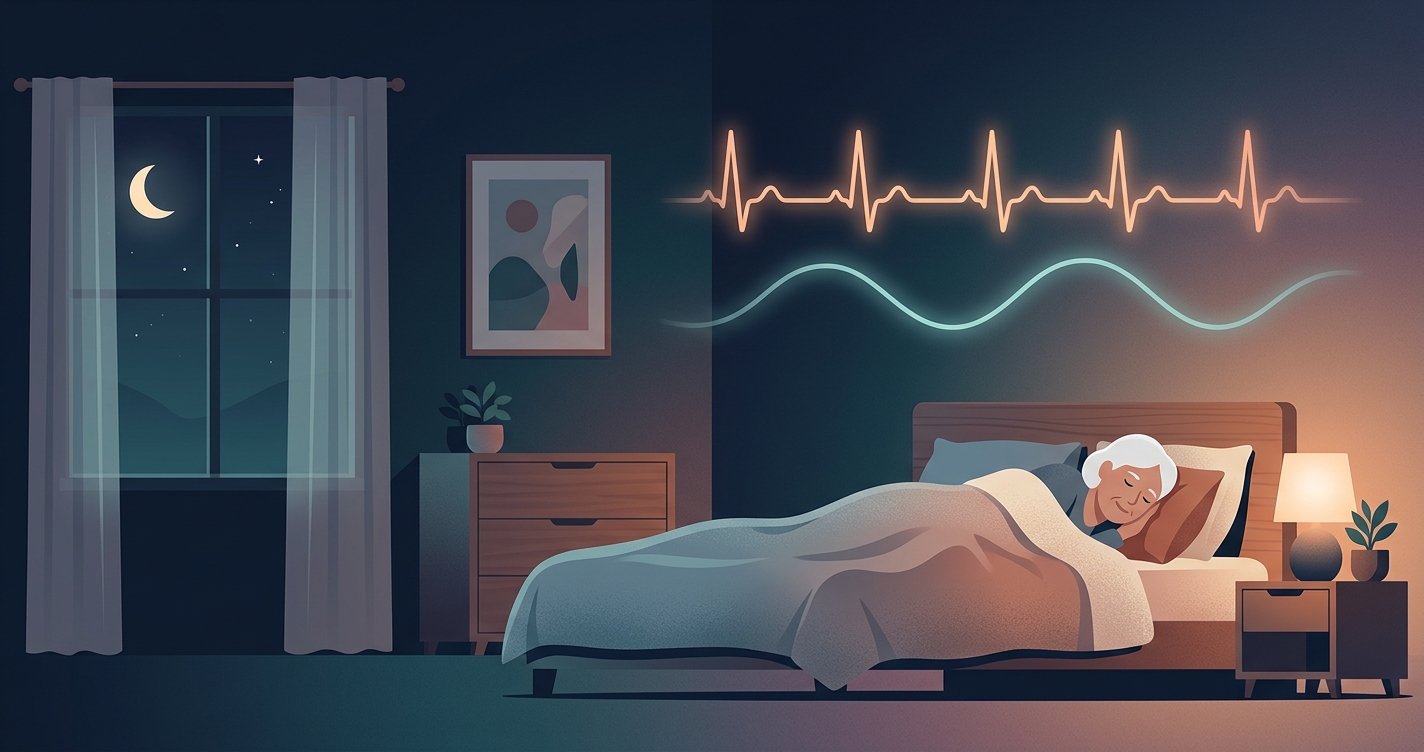
If you have ever noticed your mother sleeping later than usual, napping more during the day, or stirring restlessly through the night, you may have wondered whether it is simply part of getting older or a signal of something deeper. That instinct is well founded. A growing body of geriatric research treats sleep as one of the most information-rich periods of the day, and the nightly measurement of elderly vital signs at home is becoming a practical way for families and care providers to read those signals before a problem becomes a crisis. Sleep is no longer viewed as downtime. It is a continuous, unguarded health assessment that runs for seven or eight hours every night.
A 2022 study led by Dr. Soomi Lee at the University of South Florida found that adults with more co-existing sleep health problems had up to a 141 percent higher estimated risk of heart disease when sleep was measured objectively rather than self-reported.
Why elderly vital signs at home are easiest to read during sleep
During waking hours, an older adult's body is in constant flux. Activity, meals, stress, medication timing, and even the act of having a blood pressure cuff applied all shift the numbers. Sleep strips most of that variability away. Heart rate settles toward its true resting baseline, breathing becomes regular, and movement quiets. This makes the overnight window the cleanest opportunity to capture elderly vital signs at home and, more importantly, to compare them night over night.
The signal that matters is rarely a single alarming number. It is the trend. A resting heart rate that drifts up by eight beats per minute over a week, a breathing rate that climbs slightly each night, or a sudden increase in nighttime restlessness can all precede a clinical event. Dr. Rebecca Robbins of Brigham and Women's Hospital and Dr. Christine Spadola of the University of Miami, in research published in JAMA Network Open in 2023, found that changes in sleep patterns, particularly increased daytime napping and lengthening sleep duration, predicted health decline in older adults. The change, not the absolute value, carried the warning.
This is why a one-time reading at a doctor's visit tells you so little, and why continuous overnight data tells you so much. A sleep pattern is a baseline you can defend, question, and act on.
What different monitoring approaches actually capture
Families and care operators have several ways to observe a senior overnight, and they differ sharply in what they measure, how much they intrude, and whether an older adult will tolerate them long term. The table below compares the common approaches.
| Approach | What it captures | Intrusiveness | Long-term adherence |
|---|---|---|---|
| Wearable wristband | Heart rate, movement, some sleep staging | Must be worn and charged nightly | Often low; devices get removed or forgotten |
| Under-mattress sensor | Heart rate, breathing rate, movement | Low; hidden under bedding | Moderate; depends on bed setup |
| Bedside radar or camera | Heart rate, breathing, restlessness, presence | None; nothing to wear or touch | High; passive by design |
| Manual nightly checks | Spot vitals, observation | High; disrupts sleep, requires a person | Very low; unsustainable for caregivers |
| Panic button or pendant | Only a self-triggered alert | Must be worn | Low; useless if the senior cannot press it |
The pattern is clear. The approaches that demand action from the older adult tend to fail over time, while passive, non-intrusive methods produce the consistent night-after-night record that makes trend detection possible.
Key reasons sleep data outperforms occasional measurement:
- It captures the resting baseline without the distortion of daytime activity.
- It runs every night, so a deviation stands out against weeks of history.
- It requires nothing from a senior who may have cognitive or physical limits.
- It surfaces problems, such as sleep-disordered breathing, that only appear at night.
Industry applications for sleep-based health insight
Family caregivers
For an adult child managing care from across town or across the country, overnight data answers the question that keeps them up at night: is mom actually okay? Instead of relying on a daily phone call where a parent insists everything is fine, the caregiver sees whether sleep is fragmented, whether breathing or heart rate is trending up, and whether restlessness is increasing. It turns vague worry into specific questions for the next clinical conversation.
Home health agencies
Agencies operate under tight visit budgets and staffing shortages. Continuous overnight vitals let a nurse triage who needs an in-person visit and who is stable, without driving to every home. A rising nighttime respiratory rate can prompt an earlier assessment for a brewing respiratory infection, the kind of early signal that prevents an emergency department transfer.
Senior living and PACE operators
For operators, sleep-derived trends across many residents create a population-level early warning system. Staff can be directed toward the residents whose overnight patterns are shifting, which is a far more efficient use of attention than uniform check-ins. It also produces an objective record of resident status that supports quality reporting and family communication.
Current research and evidence
The evidence base for reading health through sleep has matured quickly. A 2023 exploratory study of community-dwelling older adults analyzed more than 6,000 nights of contactless sleep data from 37 participants and identified nightly body movement, heart rate, and breathing rate as digital biomarkers capable of flagging health deteriorations. The researchers emphasized longitudinal monitoring, the same night-over-night comparison that makes trends visible.
Sleep disruption is also a recognized early sign of acute illness in older adults. Disturbances in the sleep-wake cycle are strongly associated with delirium, and conditions such as urinary tract infections frequently present in seniors not with fever but with confusion and altered sleep, especially in those with dementia. A nightly record of restlessness and broken sleep can therefore surface an infection days before more obvious symptoms appear.
The cardiovascular link is equally well documented. Beyond Dr. Lee's 2022 findings, multiple studies connect fragmented sleep and irregular nighttime heart rate to elevated cardiovascular risk. Validation work has shown that contactless sensors can reliably track heart rate, breathing rate, and breathing disturbances during sleep in aging populations, which is what makes home-based, non-clinical monitoring scientifically credible rather than a novelty.
It is worth being honest about limits. Sleep data identifies patterns worth investigating; it does not diagnose. The value lies in catching the change early enough that a clinician can do the diagnosing.
The Future of sleep-based health monitoring for seniors
The direction of travel is toward passive, ambient measurement that an older adult never has to think about. Researchers are already building models that learn an individual's personal sleep and vital sign signature, so the alert threshold is tuned to that person rather than to a population average. An 80-year-old with a chronically high resting heart rate does not need an alarm every night; she needs an alarm when her own pattern breaks.
Three developments are likely to define the next few years:
- Personalized baselines that reduce false alarms and surface true deviations.
- Integration of overnight vitals with daytime activity for a fuller daily health picture.
- Tighter coordination between in-home data and the clinicians, agencies, and operators who can act on it.
As these systems mature, the nightly question shifts from is she breathing to is anything changing, and that is a far more useful question to be able to answer.
Frequently asked questions
Can my mother's sleep patterns really predict a health problem?
They can flag one early. Research from Brigham and Women's Hospital and the University of Miami found that shifts in sleep duration and napping predicted health decline in older adults. Sleep data does not diagnose, but a clear change in overnight vitals or restlessness is a reliable prompt to seek a clinical assessment sooner.
Do we need her to wear a device while she sleeps?
No. Non-intrusive options such as bedside cameras, radar, and under-mattress sensors capture heart rate, breathing, and movement without anything worn or charged. These passive methods produce the most consistent long-term records precisely because they ask nothing of the sleeper.
What overnight signals matter most?
Trends rather than single readings. A rising resting heart rate, an increasing breathing rate, growing nighttime restlessness, and longer or more fragmented sleep are among the most useful early signals, especially when compared against weeks of that person's own history.
Is monitoring sleep an invasion of her privacy?
It depends on the method. Approaches designed for the home minimize intrusion by capturing only the health signals needed and avoiding constant observation. The goal is a daily health check, not surveillance, and families should choose tools that make that distinction clear to the senior.
Circadify is addressing exactly this space, building non-intrusive daily health checks that read elderly vital signs at home without wearables or buttons, so families, home health agencies, and senior living operators can turn nightly sleep data into a comprehensive understanding of a loved one's health. Explore how a connected senior care program can support earlier, calmer decisions at https://circadify.com/solutions/hospital-at-home.