Fall Risk Assessment Through Daily Vital Sign Trends
Fall risk assessment vital sign trends can reveal blood pressure, heart rate, sleep, and recovery changes before a senior's next fall event.
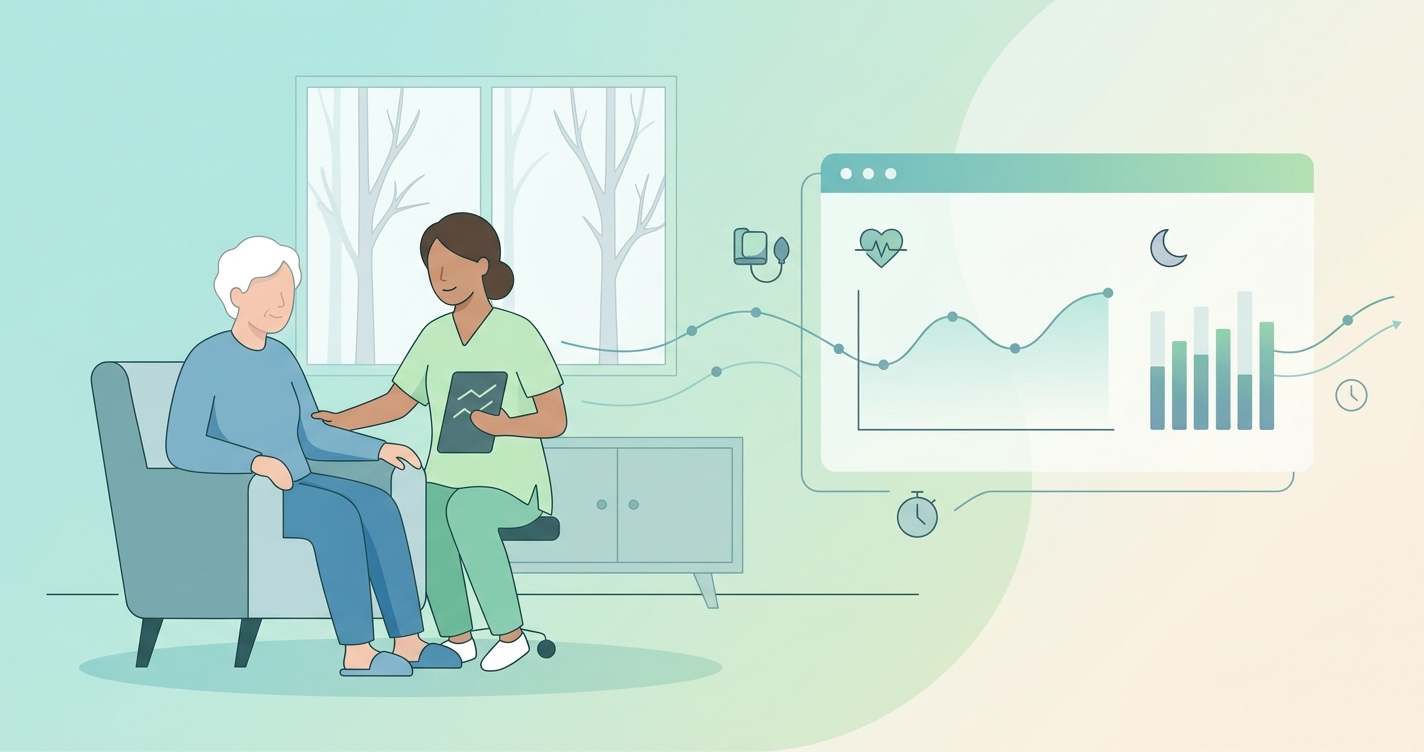
Fall risk assessment vital sign trends are getting more attention because many falls do not come out of nowhere. In older adults, the warning signs often show up first as subtle shifts in blood pressure response, resting heart rate, sleep disruption, overnight respiratory changes, or a slow drop in day-to-day recovery. For senior living teams, PACE programs, home health agencies, and family caregivers, that matters. A single daily snapshot can miss the story. A trend line is often where the real signal lives.
"Orthostatic hypotension was positively associated with falls, with an odds ratio of 1.73." — A.H. Mol and colleagues, Journal of the American Medical Directors Association (2019)
Why fall risk assessment vital sign trends matter
Traditional fall screening still relies heavily on questionnaires, mobility tests, medication review, and clinical judgment. Those tools matter, but they are episodic. They describe how someone looked in the room that day. They usually do not capture what happened across the previous two weeks: worse sleep, more time in bed, a faster resting pulse, or blood pressure instability when standing.
That gap is why daily vital sign monitoring is becoming relevant to fall prevention. A 2019 systematic review and meta-analysis led by A.H. Mol found that orthostatic hypotension, a drop in blood pressure after standing, was associated with falls across 63 studies covering 51,800 people. For care teams, this is not a minor detail. It suggests that physiologic instability is not just background noise. It is part of the fall story.
Another useful signal comes from cardiovascular regulation. In a study published in CMAJ, Giulia Ogliari, Simin Mahinrad, Behnam Sabayan, and colleagues reported that resting heart rate and heart rate variability were linked to worse functional status and future functional decline in older adults. That does not mean heart rate variability predicts every fall by itself. It does mean autonomic resilience, or the lack of it, belongs in the same conversation as balance tests and medication reconciliation.
Comparison of fall risk assessment approaches
| Approach | What it captures | Strengths | Limits | Best use case |
|---|---|---|---|---|
| Standard fall questionnaire | Prior falls, fear of falling, meds, mobility concerns | Fast and familiar | Subjective, episodic | Intake and annual reviews |
| Timed Up and Go / gait testing | Balance, gait speed, transfer ability | Clinically validated | Only captures a short visit window | Rehab and clinic screening |
| Wearable activity tracker | Steps, gait, some heart metrics | Rich movement data | Requires charging and adherence | Tech-comfortable older adults |
| Standing BP checks | Orthostatic hypotension | Direct measure of one major risk factor | Intermittent, staff-dependent | High-risk medication or dizziness review |
| Daily contactless vital sign monitoring | Heart rate, respiratory rate, sleep, bed-exit patterns, recovery trends | Passive, longitudinal, low burden | Needs interpretation in context | Ongoing home and community monitoring |
The practical point is simple: falls are rarely explained by one metric. Trend-based monitoring helps teams see stacked risk. A resident whose sleep fragments for four nights, whose overnight pulse climbs, and whose standing blood pressure has recently been unstable may need a different response than someone who simply reports feeling "a little off."
Where daily trend data can improve fall risk assessment
Daily monitoring is most useful when it adds context to known fall drivers.
- Orthostatic blood pressure changes that suggest dizziness risk during transfers
- Higher resting heart rate that may reflect pain, infection, dehydration, or poor recovery
- Lower heart rate variability, which has been associated with worse functional reserve
- Sleep disruption and repeated nighttime exits from bed, when many unwitnessed falls occur
- Reduced activity after illness or hospitalization, which can accelerate deconditioning
- Respiratory changes that may point to acute illness before weakness becomes obvious
These are not theoretical concerns. CDC data show that in 2022 about 36 million older adults reported a fall, leading to roughly 3 million emergency department visits. That is why "wait until the next assessment" is often too passive a strategy.
Industry applications
Senior living operators
In senior living, the operational problem is not just identifying who is high risk. It is identifying who is getting riskier before staff observe a fall. Daily vital sign trends can support that by flagging residents whose baseline is moving in the wrong direction. A resident with new nighttime restlessness, more bed exits, and a rising resting pulse may need medication review, hydration follow-up, or a mobility reassessment. That fits naturally with broader senior living contactless health monitoring programs that already watch for changes in daily routine.
This is especially relevant for communities trying to reduce unwitnessed overnight incidents. Night staff coverage is limited almost everywhere. Trend data can help direct attention to the residents whose pattern changed this week, not just those already labeled high risk on admission.
PACE programs
PACE organizations manage frailty, chronic disease, transportation barriers, and caregiver strain all at once. In that setting, trend-based fall risk assessment can help teams prioritize home visits and remote follow-up. If a participant's overnight recovery metrics worsen after a medication change, or if sleep and respiration shift after a recent infection, the care team has a stronger reason to intervene before the next center visit.
For PACE, this is partly a staffing issue. Continuous data does not replace clinicians. It helps them decide where scarce time should go first. The same logic shows up in PACE program monitoring without wearables, where passive data collection matters because participation drops when programs depend on another device.
Home health agencies
Home health agencies already work inside a narrow window between hospitalization and independent recovery. That window is exactly when fall risk tends to spike. Patients are weaker, routines are disrupted, and medication lists are often in flux.
Daily vital sign trends can give agencies a more textured view of recovery at home. A patient whose overnight respiratory rate rises while activity drops may be dealing with pain, poor sleep, fluid retention, or another setback that also increases fall risk. Even without making a diagnosis from the device alone, the trend can prompt a nurse call, therapist visit, or physician escalation.
Family caregivers
Family caregivers usually do not need a dashboard full of clinical jargon. They need to know whether things look stable or less stable than last week. Trend-based monitoring can make that distinction clearer. If an older parent is getting out of bed much more often at night, sleeping less, and showing weaker recovery patterns after a recent illness, the family has a reason to check in sooner or ask for clinical review.
That is a very different caregiving posture from waiting for a text that says there has already been a fall.
Current research and evidence
Research in this area is moving toward multimodal prediction rather than single-point alarms. Dimitrios E. Iakovakis, Fotini A. Papadopoulou, and Leontios J. Hadjileontiadis described a fuzzy logic-based approach using smartwatch data to estimate fall risk during everyday living activities. Their work is notable because it treats fall risk as dynamic. It changes with physiologic context.
That framing lines up with broader hospital deterioration research too. Studies of vital sign trends in inpatient wards have found that trajectories are often more informative than isolated readings. The same logic applies in elder care. A slightly elevated heart rate once may mean very little. The same elevated pattern across several days, combined with worse sleep and more nighttime exits, is harder to dismiss.
The orthostatic hypotension literature is also hard to ignore. Mol's meta-analysis found an odds ratio of 1.73 for the association between orthostatic hypotension and falls, and orthostatic hypotension is common in older populations, especially in medication-heavy and long-term-care settings. That makes blood pressure trend awareness important in any serious fall prevention program.
The cardiovascular aging literature adds another layer. Ogliari and colleagues linked lower heart rate variability and higher resting heart rate with poorer function and functional decline in older adults. For care teams, the lesson is not that autonomic metrics replace functional testing. It is that physiologic resilience and functional resilience are intertwined.
The future of fall risk assessment vital sign trends
The next phase of fall prevention will likely look less like a one-time screen and more like continuous risk surveillance. Not constant alarms. Just better context.
Three shifts seem likely.
- Fall risk models will combine mobility, sleep, heart rate, respiration, and medication events instead of relying on one category alone.
- Passive, contactless systems will matter more in older populations because adherence drops when monitoring depends on daily charging or remembering a wearable.
- Care pathways will become more targeted, with staff using trend changes to decide when to review medications, hydration, therapy intensity, or nighttime supervision.
For aging-in-place programs, that is promising because the biggest blind spot has always been the ordinary day before the crisis. Trend data can make that day more visible.
Frequently asked questions
Can daily vital sign trends actually predict falls?
Not with perfect certainty, and no responsible program should present them that way. What they can do is identify patterns associated with higher fall risk, such as orthostatic instability, worse sleep, reduced recovery, and signs of acute illness or deconditioning.
Which vital sign trend matters most for fall risk?
There is no single winner. Blood pressure response, resting heart rate, heart rate variability, sleep disruption, and nighttime bed-exit behavior all add context. The strongest programs look at patterns across several signals.
Why not rely on wearables for fall risk monitoring?
Wearables can be useful, but adherence is the problem in many older populations. Devices have to be worn, charged, and tolerated every day. Passive monitoring is often easier to sustain in senior care settings.
Who benefits most from trend-based fall assessment?
Older adults with recent hospitalization, frailty, dizziness, polypharmacy, cognitive decline, or a prior fall history are often the clearest candidates because their risk can shift quickly.
Daily, passive monitoring will not replace clinical judgment. It does give care teams and families a better chance to spot instability before it turns into an incident report. Circadify is building for this kind of senior monitoring environment, where contactless vital sign visibility can support earlier decisions in the home and community setting. Learn more at circadify.com/solutions/hospital-at-home.