How Family Caregivers Monitor Parents From a Distance
An evidence-based look at how family caregivers monitor parents remotely using passive sensors, daily vitals trends, and care coordination tools.
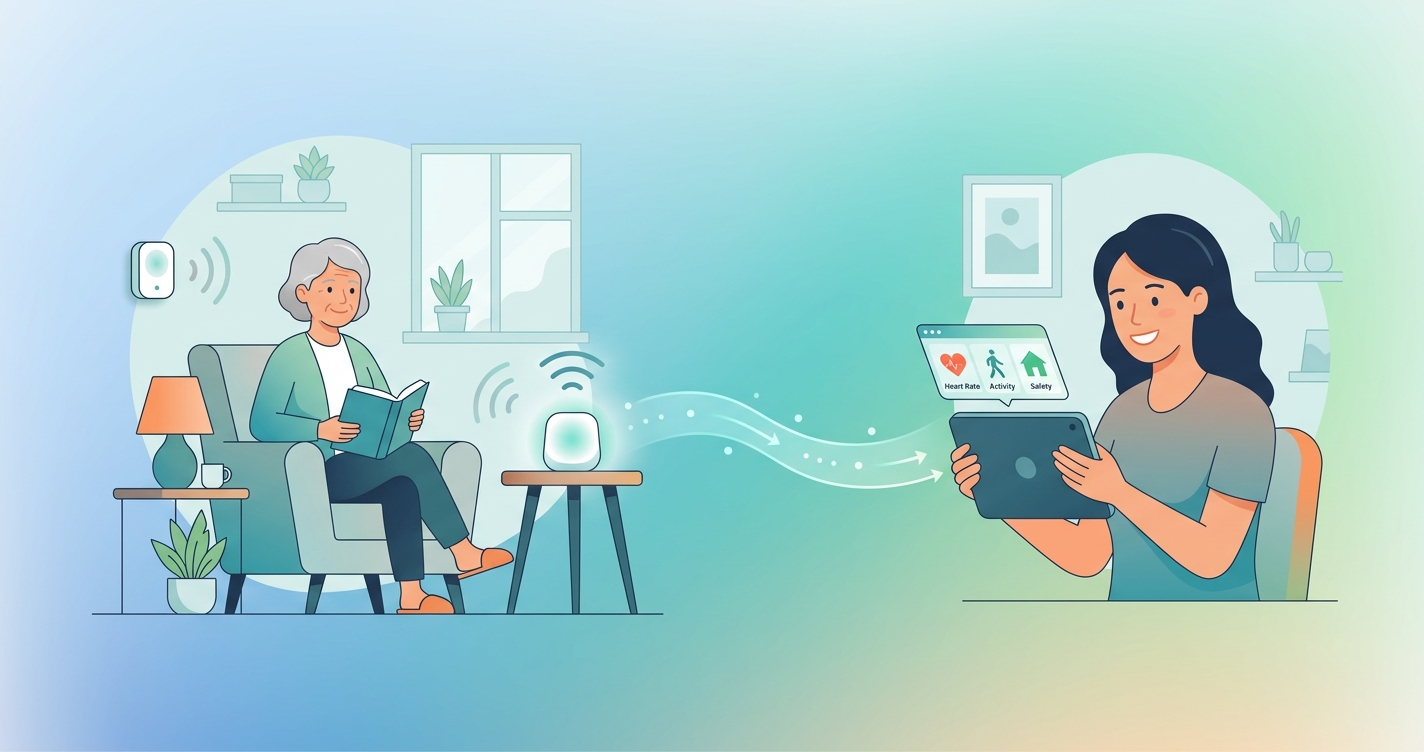
For millions of adult children, distance caregiving has become a permanent operating model rather than a temporary phase. A parent may still live independently, but the family caregiver now lives two states away, works full time, and needs more than a reassuring phone call to understand whether things are actually stable. That is why family caregivers monitor parents remotely with a mix of passive home sensing, contactless vitals capture, medication oversight, and structured check-in workflows. The shift is less about convenience than visibility: families are trying to spot changes in sleep, activity, breathing, and routine before those changes become a fall, an emergency transfer, or a late-night hospitalization.
“Remote monitoring use jumped from 13% of caregivers in 2020 to 25% in 2025.” — Caregiving in the US 2025, AARP and the National Alliance for Caregiving
How Family Caregivers Monitor Parents Remotely Today
Remote caregiving used to mean a patchwork of phone calls, neighbor check-ins, and instinct. The technology stack is now much broader. Instead of asking a parent to remember symptoms accurately, families can review objective trend data collected in the background.
The strongest systems are passive. That matters because adherence drops when older adults have to charge a device, open an app, or remember a workflow every day. In a 2025 multiprovincial randomized controlled trial published in JMIR Aging, Lisa Donelle and colleagues found that passive remote monitoring in home care was associated with a 30% reduction in the risk of admission to higher levels of care in Ontario, though the result was not statistically significant across all settings. Even with that caution, the study is notable because it tested monitoring in the real world, with patient-caregiver pairs and standard home care services rather than a tightly controlled lab environment.
Researchers at Oregon Health & Science University have been making a similar point for years: what families need is continuous context. A 2024 Journal of Medical Internet Research paper by Laura M. Miller, Jeffrey Kaye, and colleagues described remote passive sensing as a practical way to assess daily function in the home, including movement patterns and routine changes that often escape a clinic visit. That is exactly the gap distance caregivers struggle with.
Comparison: Common Ways Families Monitor Aging Parents From a Distance
| Approach | What the caregiver learns | Resident burden | Typical strength | Main limitation |
|---|---|---|---|---|
| Daily phone call | Mood, responsiveness, self-reported symptoms | Low | Preserves human connection | Depends on memory and honesty |
| Wearable device | Heart rate, steps, sleep when worn | High | Rich data during compliance | Charging and long-term adherence problems |
| Medication dispenser alerts | Doses taken or missed | Moderate | Useful for adherence oversight | Says little about physiology |
| Passive motion sensors | Room-to-room activity, nighttime movement, routines | None | Good for behavioral change detection | No direct vital signs |
| Under-mattress or bedside contactless monitoring | Sleep, heart rate, respiratory rate, bed exits | None | Strong for early deterioration signals | Mostly captures nighttime physiology |
| Camera-based vital sign check-ins | Pulse and breathing during a quick scan | Low | Simple spot checks without wearables | Requires the parent to participate |
| Home health or agency dashboard | Combines monitoring with clinician review | Low for resident | Better care coordination | Depends on service availability and cost |
A distance caregiver usually does not need every one of these tools. The useful pattern is layered monitoring: one passive system for daily baseline visibility, one workflow for medication or appointment adherence, and one communication channel that includes family plus any formal care team.
- Passive monitoring works best when the parent does not have to change behavior.
- Nighttime data is often the earliest warning layer because sleep disruption and respiratory shifts appear before families notice daytime decline.
- Families get more value from trends than isolated readings.
- The best remote oversight model combines technology with a human response plan.
Industry Applications for Long-Distance Family Caregiving
Aging in place households
For a parent living alone, the first question is usually not “What is their pulse right now?” It is “Are they still following the same rhythm they followed last month?” A drop in kitchen activity, more overnight bathroom trips, later wake times, or several restless nights in a row can point to infection, medication side effects, or worsening heart or lung disease. This is why many families start with the same kinds of tools covered in our analysis of aging in place technology.
Home health coordination
When a parent already receives home health visits, remote monitoring becomes more valuable because somebody can act on the data. Families can flag a trend before the next scheduled visit rather than waiting for a visible crisis. In practice, this turns the caregiver from anxious observer into informed coordinator. It also overlaps with the workflow questions discussed in our post on daily health checks for independent living.
Dementia and cognitive decline support
Cognitive decline changes the monitoring equation. Self-report becomes less reliable, while routine disruption becomes more meaningful. The ORCATECH and CART research programs helped establish this idea by showing that unobtrusive in-home sensing can capture functional change earlier than occasional office assessments. For families, that means wandering risk, nighttime wakefulness, and changes in room transitions can be as important as a conventional vital sign.
Post-discharge oversight
The 30 days after a hospitalization are often the hardest window for distance caregivers. The parent sounds better on the phone, but recovery can still be fragile. Contactless overnight monitoring and simple daily scans create a clearer trendline during this period, especially for heart failure, COPD, and frailty-related recovery.
Current Research and Evidence
The research base behind remote monitoring for older adults is getting more practical, which is good news for caregivers who need evidence they can actually use.
In JMIR Aging (2025), Donelle, Hiebert, Warner, Reid, and colleagues studied 313 patient-caregiver pairs across Ontario and Nova Scotia. Their passive remote monitoring model included tools such as motion sensors, cameras, and door alarms added to standard home care. The headline result was mixed by province, but the Ontario arm showed a 30% lower risk of admission to higher levels of care. That is not proof that technology alone keeps people home. It is evidence that passive monitoring can support aging-in-place strategies when paired with care services.
In JMIR mHealth and uHealth (2024), K.K.G. Ravindran, Chiara Della Monica, Derk-Jan Dijk, and coauthors evaluated three contactless sleep-monitoring technologies in community-dwelling adults aged 65 to 83. All three showed acceptable accuracy for heart rate and breathing rate estimation during sleep. For families, the practical takeaway is simple: nighttime contactless monitoring is no longer a speculative concept. It is becoming a credible source of recurring physiological data.
The CART initiative paper in Innovation in Aging (2020), led by Zeke Beattie with Laura Miller, Hiroko Dodge, Jeffrey Kaye, and other collaborators, described an open, technology-agnostic platform for long-term in-home monitoring. That program matters because it helped normalize continuous home sensing as a research-grade way to study aging, function, and early decline outside the clinic.
A 2024 Journal of Medical Internet Research article by Miller, Kaye, Andrea Lindauer, and colleagues pushed the conversation further by focusing on user-centered design. Older adults and families are more likely to accept passive monitoring when the technology is unobtrusive, the data being collected is clearly explained, and the system supports independence rather than surveillance. I think that last point gets missed all the time. Families do not want a spy tool. They want fewer blind spots.
The Future of Remote Monitoring for Family Caregivers
The next phase will be less about adding more gadgets and more about reducing friction.
First, passive systems will keep replacing compliance-heavy ones. That is especially likely in senior living, home health, and PACE-adjacent models where staff cannot spend all day troubleshooting wearables.
Second, family dashboards will become more collaborative. Instead of one adult child receiving every alert, systems will route information to siblings, aides, nurses, and care managers based on severity. That sounds obvious, but it fixes a real problem: one person carrying all the context.
Third, the distinction between consumer monitoring and clinical workflow will keep shrinking. As home-based care expands, families will expect the same data stream to support reassurance at home and escalation to professional care when needed.
Finally, camera-based and contactless vital sign platforms are likely to grow because they fit the reality of older adults who do not want another device on their body. Solutions in this category, including platforms like Circadify, are being brought to market to support non-intrusive daily health checks and more coordinated home-based care.
FAQ
What is the best way for family caregivers to monitor parents remotely?
The most sustainable model usually combines passive monitoring with a clear response workflow. Families need visibility into trends such as sleep, activity, and respiratory changes, plus a plan for who acts when those trends shift.
Do older adults have to wear a device for remote monitoring to work?
Not always. Many of the newer systems used in aging-in-place settings rely on passive motion sensors, under-mattress monitoring, or short camera-based vital sign checks instead of full-time wearables.
What changes are most useful for caregivers to watch?
The most actionable changes are often deviations from a personal baseline: less movement, rising nighttime respiratory rate, repeated bed exits, worsening sleep quality, or sudden changes in routine after medication changes or a hospital stay.
Is remote monitoring a replacement for caregiving visits or phone calls?
No. It works best as a supplement. Sensor data can show what changed, but families still need conversations, in-person visits, and clinician input to understand why it changed and what to do next.
Families, senior care operators, and home health teams looking at non-intrusive monitoring models can explore how contactless vital sign platforms fit aging-in-place programs at Circadify’s hospital-at-home solutions.