How to Check Elderly Vital Signs at Home Without a Wearable
A practical guide for families on how to track elderly vital signs at home, including heart rate, breathing and sleep, without a device a parent refuses to wear.
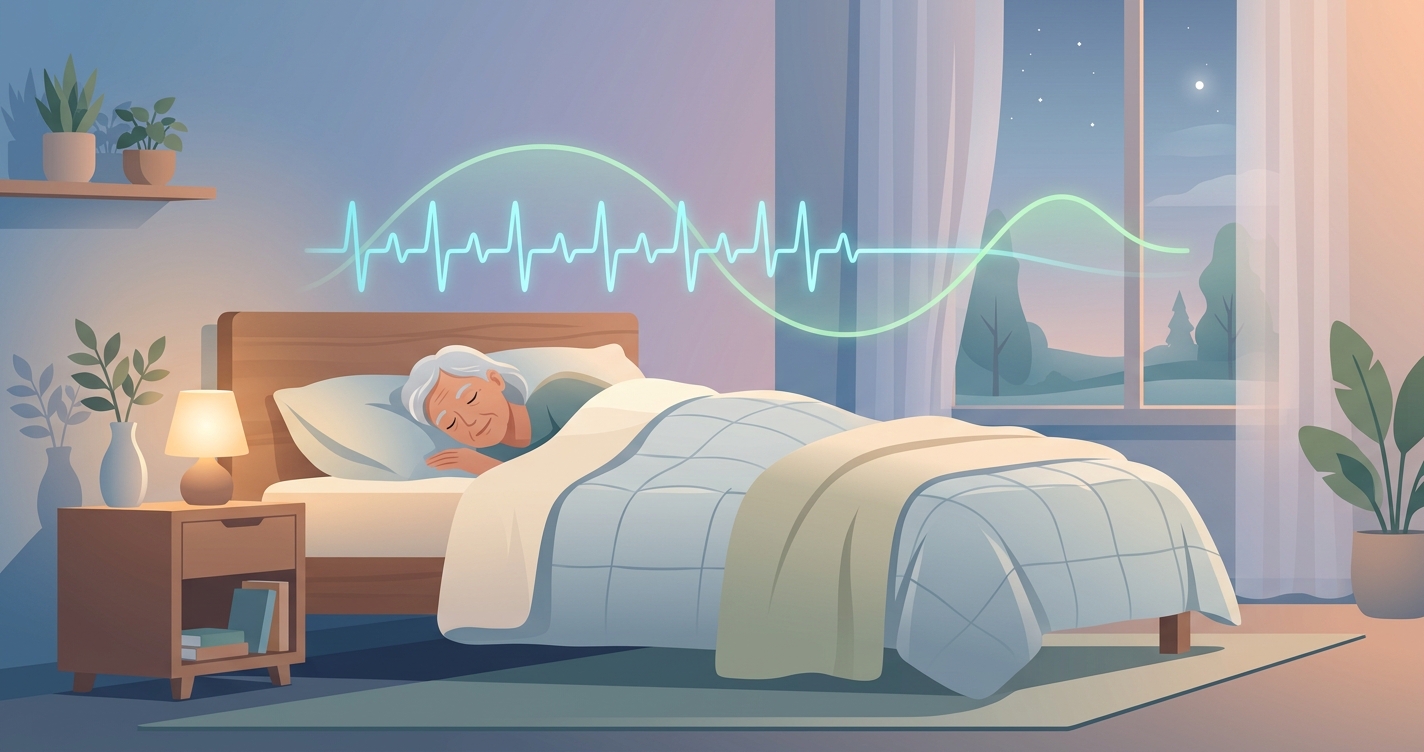
Most adult children eventually find themselves standing in a parent's bedroom doorway, watching for the rise and fall of a chest or pressing two fingers to a wrist, trying to confirm that everything is fine. The instinct is sound. The method is not. Tracking elderly vital signs at home gives families a real read on a parent's day-to-day health, but the moment you reach for a wearable, you hit the wall that defines this entire problem: many older adults will not wear the thing. A wristband ends up in a drawer, a chest strap is abandoned by the second night, and a charging cable becomes one more task no one remembers. The good news is that the most informative vital signs can be checked without asking a parent to wear, press, or charge anything at all.
A respiratory rate above 27 breaths per minute was the single most important predictor of cardiac arrest on hospital wards, yet breathing rate remains the most frequently omitted vital sign in routine care, according to research published in the Medical Journal of Australia by Michelle Cretikos and colleagues in 2008.
That gap matters at home too. The numbers that warn families earliest are often the ones manual checks miss.
What elderly vital signs at home actually tell you
Before choosing a method, it helps to know what you are looking for and why each measurement carries weight. The four signals worth tracking in an aging parent are heart rate, respiratory rate, sleep, and movement or activity. Each one drifts in a predictable direction when something is wrong, and the drift usually starts days before a visible crisis.
- Resting heart rate. For most older adults this sits between 60 and 100 beats per minute, with many healthy seniors landing in the 60 to 80 range. A resting rate that climbs over several nights can flag infection, dehydration, or a heart issue.
- Respiratory rate. Normal is roughly 12 to 20 breaths per minute, and it tends to rise slightly with age. Research summarized by John Subbe and others has long shown that a rising breathing rate is one of the earliest signs of deterioration, often appearing before heart rate or blood pressure shift.
- Sleep quality and duration. Fragmented sleep, more daytime napping, or a parent suddenly sleeping far later than usual can signal anything from a medication problem to early illness.
- Nighttime movement and restlessness. Tossing, frequent waking, or getting up repeatedly can point to pain, breathing trouble, or a urinary infection.
The single most useful idea for families is this: one reading tells you almost nothing, but a trend tells you a great deal. A heart rate of 88 means little on its own. A heart rate that has climbed from 68 to 88 over four nights is a conversation with a doctor.
Methods to check senior vitals at home, compared
There is no single right tool. The honest answer depends on what a parent will tolerate and how consistent the data needs to be. The table below compares the realistic options families weigh when they want to monitor elderly heart rate and breathing without a constant battle.
| Method | What it measures | Wearable required | Works while sleeping | Consistency for trends | Main limitation |
|---|---|---|---|---|---|
| Manual pulse and breath count | Heart rate, respiratory rate | No | No | Low | Depends on a person being present and counting correctly |
| Fingertip pulse oximeter | Heart rate, blood oxygen | No (handheld) | No | Low to medium | Requires the senior to sit and use it on demand |
| Blood pressure cuff | Blood pressure, heart rate | No (worn briefly) | No | Medium | Spot reading only, not continuous |
| Wrist or ring wearable | Heart rate, sleep, movement | Yes | Yes | High when worn | Often refused, removed, or left uncharged |
| Under-mattress sensor | Heart rate, breathing, sleep | No | Yes | High | Bed-only, misses daytime |
| Contactless camera-based monitor | Heart rate, breathing, sleep, movement | No | Yes | High | Needs clear placement and good lighting |
The pattern is clear. The methods that produce reliable trends usually demand either a wearable a parent rejects or a person standing by with a stopwatch. The contactless and ambient options break that trade-off by collecting data passively, without asking the older adult to do anything differently.
How no-wearable vitals monitoring works
Families are often surprised that heart rate and breathing can be measured with a camera at all. The underlying science is called remote photoplethysmography, or rPPG. A camera detects the tiny color changes in the skin that happen with each heartbeat as blood pulses through surface vessels, changes invisible to the human eye but readable by software. Breathing rate is captured by tracking the subtle rise and fall of the chest and shoulders.
The accuracy has improved sharply. A 2023 evaluation of a smartphone-based rPPG application reported roughly 97 percent agreement with reference devices for heart rate and about 84 percent for respiratory rate. Camera-based heart rate and respiratory monitoring using on-device AI, studied by researchers at the University of Plymouth and published in 2023, showed that contactless capture can reach clinical-grade ranges under good conditions. These tools are not a replacement for a clinician's diagnosis, but for home trend tracking they outperform a worried family member counting breaths in the dark.
For families, the practical appeal is simple:
- Nothing to wear, charge, or remember.
- Data is collected during normal sleep and daily routine.
- Trends build automatically rather than depending on someone being present.
- A parent keeps their independence and privacy is preserved by design in well-built systems.
Industry applications of home vital sign tracking for seniors
The same approaches families use at home are being adopted across senior care, which is part of why the technology has matured so quickly.
Home health and aging in place
Home health agencies use ambient and contactless monitoring to fill the long gaps between in-person visits. A nurse who visits twice a week can review nightly heart rate and breathing trends to decide whether the next visit needs to come sooner.
Assisted living and PACE programs
Senior living operators and Program of All-Inclusive Care for the Elderly teams use passive monitoring to catch early deterioration across many residents at once, prioritizing staff attention toward the people whose numbers are drifting.
Family distance caregiving
For the adult child living hundreds of miles away, no-wearable vitals turn a vague worry into a concrete signal. Instead of calling to ask how a parent slept, they can see that sleep has been steady and breathing normal.
Current research and evidence
The evidence base supports two claims families care about most. First, the right vital signs predict trouble early. The work by Cretikos and colleagues in 2008 established respiratory rate as a leading warning sign, and a frequently cited study on raised respiratory rate in elderly patients found that breathing rate often rose 24 hours or more before a recognized clinical event. Tracking it at home, continuously, captures exactly the signal that intermittent checks tend to miss.
Second, contactless measurement has become accurate enough for trend monitoring. The 2023 Plymouth research and multiple peer-reviewed reviews of rPPG methods confirm strong heart rate accuracy, with respiratory rate close behind. Researchers consistently note three things that affect quality: motion, lighting, and skin tone. Good system design accounts for all three, which is why purpose-built monitors tend to outperform a do-it-yourself phone setup.
It is worth stating plainly what the research does not say. No camera or sensor diagnoses disease, and none replaces a doctor. Their value is in noticing change early and prompting a human to take a closer look.
The future of elderly vital signs at home
The direction is toward monitoring that disappears into the background. Several shifts are already underway:
- Multi-signal fusion, combining heart rate, breathing, sleep, and movement into a single picture rather than isolated numbers.
- Trend-based alerts that flag a meaningful change rather than a single odd reading, cutting down on false alarms that exhaust families.
- Integration with care teams, so a worrying pattern at home reaches a home health nurse or PACE clinician without the family having to interpret raw data.
- Stronger privacy engineering, with on-device processing that extracts vital signs without storing identifiable video.
The endpoint is a home where an aging parent lives normally, wears nothing, and is quietly watched over by a system that speaks up only when it should.
Frequently asked questions
Can you really measure heart rate and breathing without any wearable?
Yes. Contactless methods read heart rate from subtle skin color changes and breathing from chest movement, both captured by a camera. Under good lighting and with minimal motion, 2023 studies reported heart rate accuracy near 97 percent, making it suitable for tracking trends at home.
What elderly vital signs should families track first?
Start with resting heart rate, respiratory rate, and sleep. Breathing rate is especially valuable because research shows it often rises before other signs when an older adult is becoming unwell, yet it is the measurement manual checks most often skip.
Why not just use a smartwatch or fitness band?
Wearables work well when worn, but the core problem is adherence. Many seniors remove them, forget to charge them, or refuse them outright, which leaves the data full of gaps. No-wearable options keep collecting through normal sleep and routine.
When should a vital sign change prompt a call to the doctor?
Act on trends, not single readings. A resting heart rate that climbs steadily over several days, a breathing rate consistently above 20 at rest, or a clear shift in sleep pattern are all worth discussing with a clinician, especially when more than one signal moves together.
Circadify is building toward this contactless future for senior care, with non-intrusive daily health checks that track heart rate, breathing, and sleep using a camera rather than a device a parent will not wear. Families and care teams who want to see how passive vital sign monitoring fits into a home-based care plan can explore the approach through Circadify's senior care program at circadify.com/solutions/hospital-at-home.