How can I keep an eye on my mom's health from across the country?
Learn about the challenges and solutions for long-distance caregiving. Explore how new technology allows you to monitor a parent's health without wearables.
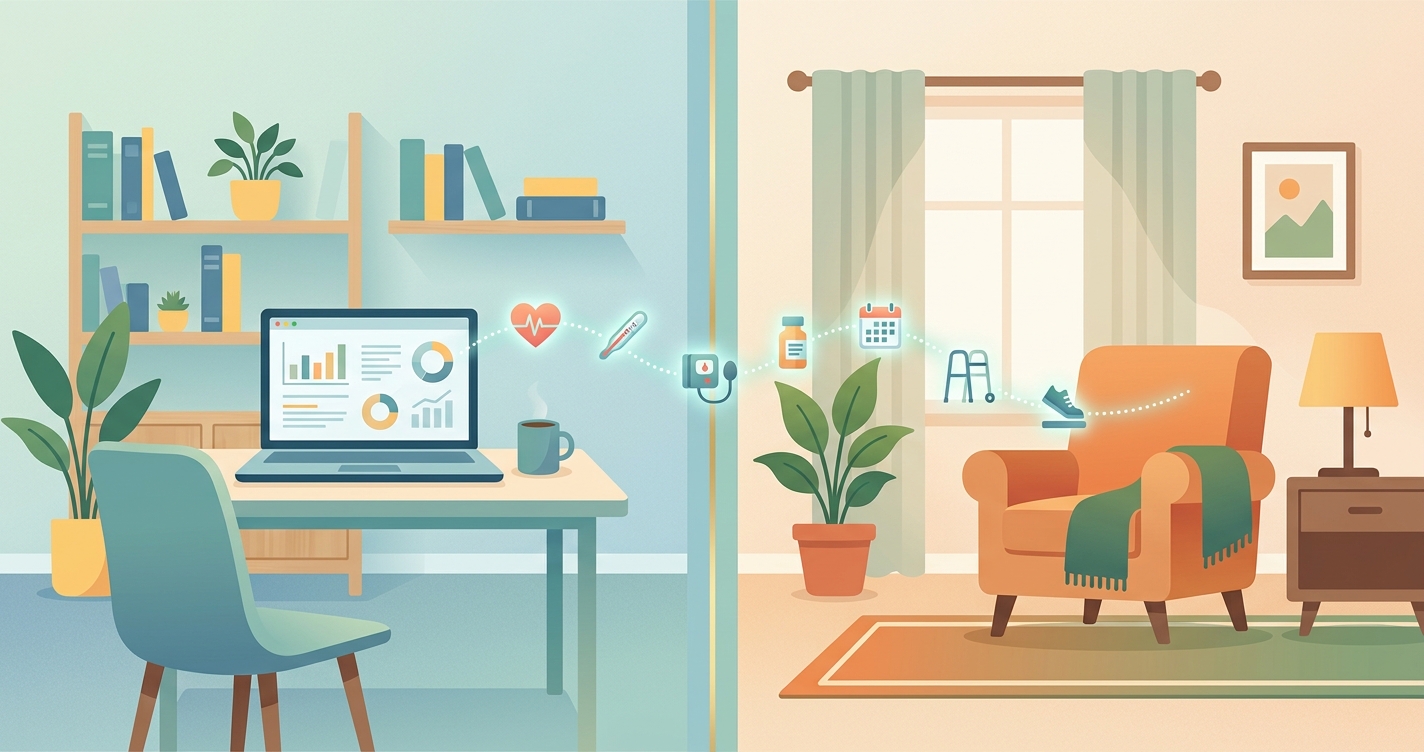
The feeling of being geographically separated from an aging parent is a heavy, modern reality for millions. You want to honor their independence, but a constant, low-level worry persists. Are they okay today? Did they take their medications? Is a small issue going unnoticed that could become a crisis? This distance can feel like a barrier to providing good care, but a growing field of technology is changing the paradigm of what is possible for long-distance caregivers.
"More than one in ten of all family caregivers are long-distance caregivers who live an hour or more away from their care recipient. These 5 million caregivers... are more likely to report physical and financial strain than caregivers who live closer."
- National Alliance for Caregiving and AARP, "Caregiving in the U.S. 2020"
The challenge of a long distance caregiving monitor for parent health
For the millions of adult children who do not live near their parents, the primary tools for connection have traditionally been the phone call and the planned visit. While essential for emotional connection, these methods are unreliable for objective health assessment. A parent may sound "fine" on the phone, intentionally hiding symptoms to avoid being a burden or genuinely not noticing gradual but significant changes in their own health. Infrequent visits can reveal a sudden decline, leaving the family to wonder what warning signs were missed in the intervening weeks or months. This is the core challenge of the long distance caregiving monitor parent health dilemma: how to gather objective, daily data without being physically present.
This lack of daily insight creates a reactive care model. A family member, neighbor, or the parent themselves must recognize a problem and actively seek help. Unfortunately, by the time many of these problems become obvious, they have already escalated into a serious event like a fall, a medication error, or a hospitalization that might have been preventable with earlier detection of subtle warning signs.
| Monitoring Method | How It Works | Pros | Cons |
|---|---|---|---|
| Daily Phone Calls | Voice or video calls to check in. | - Strengthens emotional bond. - Low cost. | - Subjective; relies on self-reporting. - Misses gradual, non-obvious changes. - Can feel like a burden to parent. |
| PERS / Panic Buttons | A wearable button pushed in an emergency to alert a call center. | - Provides a lifeline in an acute emergency like a fall. | - Entirely reactive; provides no data until an event occurs. - Requires senior to wear it and be able to use it. - High rate of false alarms or non-use. |
| Wearable Health Devices | Smartwatches or fitness trackers that measure activity, heart rate, etc. | - Can collect continuous or spot-check data. - Some models offer fall detection. | - Requires charging and user interaction. - Often resisted by seniors ("don't want to wear that"). - Data can be complex to interpret for a layperson. |
| Contactless Monitoring | Ambient sensors or camera-based systems that gather data with no user action required. | - Entirely passive; no action needed from the senior. - Collects objective data on vital signs and activity daily. - Trends can be shared with family to show changes over time. | - Requires professional installation. - Can have a higher upfront cost. - Perceived privacy concerns must be addressed. |
Industry applications: from panic buttons to passive sensing
The market has evolved significantly to provide better tools for long-distance caregiving and to monitor parent health from afar.
Traditional tools and their limits
For decades, the Personal Emergency Response System (PERS), or "panic button," was the primary technology for aging in place. While valuable, its function is entirely reactive. It does nothing until the user has a fall or another emergency and is able to press the button. It offers no insight into the gradual decline in mobility, elevated resting heart rate, or disturbed sleep patterns that often precede such an event.
The rise of wearable technology
The consumer wellness boom introduced a new category: smartwatches and wearable health trackers. These devices brought the ability to track metrics like activity levels, heart rate, and sleep. However, their effectiveness in the senior population faces a significant barrier: user adherence. A 2023 AARP report on tech trends noted that while seniors are adopting technology, barriers like complexity remain. For a device to be effective, it must be worn, charged, and synced. Many seniors find this burdensome or simply refuse to wear a "gadget," leaving the caregiver back at square one.
A new approach: contactless health monitoring
The most recent innovation addresses the adherence problem directly. Contactless monitoring uses ambient sensors, most commonly advanced camera technology paired with sophisticated software, to gather health data from a distance, without requiring the senior to wear, touch, or do anything. By placing a device on a table or mounting it on a wall, it can measure key vital signs like breathing rate, heart rate, and skin temperature, simply by observing the individual as they go about their day. This approach finally solves the central problem: it provides a consistent, objective stream of data for a long distance caregiving monitor parent health strategy, shifting care from reactive to proactive.
Current research and evidence
The move toward remote data collection is supported by a large body of clinical research. While much of the early research focused on wearable-based Remote Patient Monitoring (RPM), the findings highlight the value of daily data. A 2022 meta-analysis by Cajita et al. published in the Journal of Medical Internet Research found that interactive RPM could lead to better health outcomes. However, the "interactive" component is often the point of failure in real-world senior care.
The core benefit of remote monitoring lies in trend analysis. A single blood pressure reading is just a snapshot, but a trend of rising blood pressure over three weeks tells a story and enables intervention. This is where passive, contactless monitoring excels. It removes the burden from the senior and provides the consistent data stream that allows caregivers and clinicians to see subtle changes that could indicate:
- A worsening chronic condition (e.g., congestive heart failure signaled by rising breathing rate).
- The side effects of a new medication.
- An emerging infection.
- A decline in mobility and increased fall risk.
A 2022 study by Iglesias et al., also in the Journal of Medical Internet Research, on older adults with multiple chronic conditions found that remote monitoring could reduce emergency department visits. The key is catching negative trends before they become emergencies.
The future of long-distance caregiving
The future of elder care technology is ambient and data-driven. The ideal for a long-distance caregiver is a system that "just works" in the background, providing peace of mind and actionable insights. Artificial intelligence will play a larger role in analyzing the raw data from these passive sensors to identify complex patterns that even a trained human eye might miss. The goal is not to replace human connection but to enhance it. Knowing that a parent's vital signs are stable allows phone calls to be about connection, not interrogation. When an alert does come, it is based on objective data, enabling a more focused and effective conversation with the parent and their local care team.
Frequently asked questions
How can I monitor my parent's health without being intrusive? The least intrusive method is contactless or ambient monitoring. These systems use cameras or other sensors to gather health data from a distance without requiring the senior to wear any device or change their routine. It respects their privacy and independence while still providing crucial daily insights.
My mom refuses to wear a device. What are my options? This is a very common problem. If a wearable device is off the table, your best option is a contactless monitoring system. Since it requires no action on her part, her refusal to wear a gadget is no longer a barrier to monitoring her health and safety.
What are the most important health signs to track for a senior living alone? While specific conditions vary, tracking trends in a few key areas provides a strong overall picture. These include resting heart rate, respiratory rate, sleep duration and quality, and general mobility or activity levels. A significant change in any of these trends warrants a conversation.
Is it expensive to set up remote monitoring for a parent? Costs can vary widely. Simple apps and wearables may have a low upfront cost but often come with monthly subscriptions and the hidden cost of non-adherence. Professional, contactless systems may have a higher initial hardware and installation cost but provide more reliable and consistent data, which can prevent the much higher cost of an emergency room visit or hospitalization.
For families and care providers navigating the complexities of long-distance caregiving, new technologies are closing the distance. By providing a clear, objective window into a parent's daily health, these systems empower families to act proactively and provide better care from anywhere. Circadify is at the forefront of developing these non-intrusive monitoring solutions to support aging in place. To learn more about how this technology is being used in programs like Hospital-at-Home, visit circadify.com/solutions/hospital-at-home.