Is there a way to know if my elderly relative is sleeping well from my phone?
How contactless monitoring tracks elderly vital signs at home overnight, giving family caregivers and senior living operators a window into sleep quality without wearables.
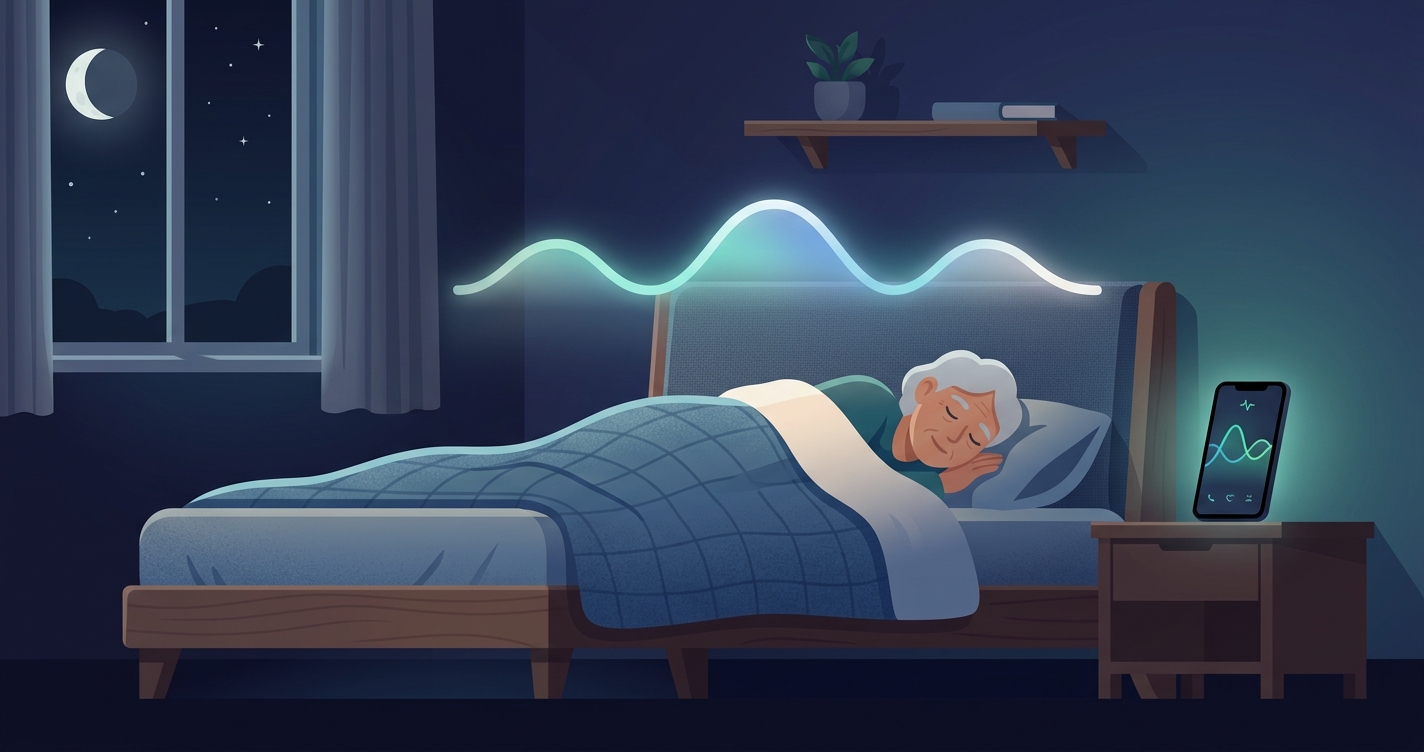
If you have ever lain awake wondering whether your mother actually slept last night, or whether the restlessness she mentioned at breakfast is a passing complaint or an early signal of something larger, you already understand the gap that modern monitoring is trying to close. Sleep is one of the most honest indicators of an older adult's health, yet it has historically been the hardest thing to observe from a distance. The arrival of contactless systems that can track elderly vital signs at home during the night is changing that calculation, giving family caregivers and senior living operators a structured view of sleep without asking the person being monitored to wear, charge, or press anything.
A 2024 evaluation in JMIR mHealth and uHealth found that contactless bedside and under-mattress devices estimated overnight heart rate within a mean absolute error of under 2.12 beats per minute and breathing rate within 1.6 cycles per minute when compared against clinical polysomnography in adults aged 65 to 83.
Why elderly vital signs at home matter most overnight
Sleep is not a passive state. Across a night, an older adult's heart rate, breathing rate, and movement shift in patterns that reflect both sleep architecture and underlying health. When those patterns degrade, the consequences are rarely contained to the bedroom. According to specialists at UT Southwestern Medical Center, poor sleep in older adults is associated with higher blood pressure, increased fall risk, cognitive decline, cardiovascular disease, and a measurable rise in mortality risk. Roughly half of older adults report symptoms of insomnia, and sleep researchers consistently note that disturbed sleep is a consequence of medical conditions and medications rather than a normal feature of aging.
That distinction is what makes overnight tracking of elderly vital signs at home valuable. A single restless night tells you little. A trend of fragmented sleep, rising nighttime breathing rate, or growing periods of wakefulness can be an early signal of infection, heart strain, undiagnosed sleep apnea, or a medication that needs review. The question is not whether sleep matters. It is whether you can observe it without disrupting the very rest you are trying to measure.
The honest answer to "can I know this from my phone?" is a qualified yes. A phone does not measure anything by itself. It serves as the display surface for a system that does the sensing in the room. The sensing technology falls into a few distinct categories, each with real tradeoffs.
| Approach | What it tracks overnight | Wearable required | Best fit |
|---|---|---|---|
| Camera-based contactless | Breathing rate, movement, presence, derived sleep periods | No | Caregivers wanting a visual plus vitals from a phone |
| Bedside radar | Breathing rate, heart rate, sleep stages, apnea events | No | High-detail sleep and breathing analysis |
| Under-mattress sensor | Heart rate, breathing rate, movement, time in bed | No | Continuous bed-based tracking |
| Wrist wearable | Heart rate, movement, estimated sleep stages | Yes | Active seniors who tolerate devices |
| Manual caregiver check | Snapshot observation only | No | Spot checks, not overnight trends |
The pattern across the contactless options is consistent. Devices that sit in the room, rather than on the body, remove the largest barrier to overnight monitoring for older adults: compliance. A wearable only works if it is worn, charged, and not removed in confusion at 2 a.m. A bedside or camera-based system simply observes.
- No charging routine for the senior to manage
- Nothing to forget, lose, or refuse to wear
- Data collected every night rather than only on cooperative nights
- Trends visible to a remote caregiver through an app
- Less disruption for residents with cognitive impairment
Industry applications across the senior care continuum
Family caregivers monitoring from a distance
For an adult child living in another city, the value is continuity. Instead of relying on a parent's self-report, which can be vague or downplayed, the caregiver sees objective overnight data each morning: how long the person was in bed, how settled their breathing was, how often they were up. This converts a vague worry into a reviewable pattern, and it gives families a concrete basis for raising concerns with a physician.
Senior living and assisted living operators
For operators, overnight monitoring of elderly vital signs at home or in a resident apartment extends staff reach without adding overnight room checks that wake residents. A night nurse covering dozens of units cannot physically observe every resident's breathing. A passive system flags the resident whose nighttime breathing rate has climbed for three consecutive nights, letting limited staff focus attention where the data points.
PACE programs and home health agencies
PACE programs and home health agencies operate under pressure to prevent avoidable hospitalizations. Sleep and overnight vitals are leading indicators. A participant whose resting heart rate during sleep trends upward, or whose sleep becomes increasingly fragmented, may be decompensating days before a daytime symptom appears. Contactless overnight data feeds the same clinical review process these programs already run, without requiring the participant to operate equipment.
Current research and evidence
The clearest evidence comes from direct comparisons against polysomnography, the gold standard of sleep measurement. In the 2024 JMIR mHealth and uHealth study led by researchers evaluating digital health technology in aging, 35 community-dwelling adults aged 65 to 83 used contactless devices at home for 7 to 14 nights and then underwent in-lab polysomnography. All three contactless technologies, two under-mattress trackers and one bedside radar, reached acceptable accuracy for heart rate and breathing rate at one-minute resolution, with the bedside radar performing best for breathing rate and breathing disturbance detection.
That accuracy matters because it establishes that room-based sensing is not merely convenient but clinically credible for the core overnight signals. The research also reinforces why breathing rate deserves attention: it is among the most reliably captured contactless metrics and one of the earliest to shift in respiratory and cardiac decline.
The companion literature on outcomes strengthens the case. A systematic review on sleep and healthy aging published through the National Institutes of Health links sleep quality to cognitive and cardiovascular outcomes, and analysis reported by PsyPost found that good sleep quality was associated with a 69 percent lower risk of depressive symptoms in older adults. When the thing you can now measure passively is also the thing tied to major downstream outcomes, the rationale for continuous observation becomes straightforward.
- Contactless heart rate error under 2.12 bpm against polysomnography (JMIR, 2024)
- Contactless breathing rate error at or below 1.6 cpm (JMIR, 2024)
- Roughly half of older adults report insomnia symptoms (UT Southwestern)
- Good sleep quality linked to 69 percent lower depression risk (PsyPost reporting)
The future of overnight elderly monitoring
The direction of travel is toward integration and earlier prediction. Standalone sleep numbers are useful, but their real power emerges when overnight breathing and heart rate are combined with daytime activity, medication timing, and longer baselines unique to each individual. A deviation only means something relative to that person's normal, and multi-night baselines are what make a single bad night interpretable.
Three shifts are likely to define the next phase. First, sensing will move further from the body, with camera and radar approaches reducing reliance on anything the senior must tolerate. Second, analysis will shift from reporting to flagging, surfacing the specific resident or relative whose pattern has changed rather than presenting raw charts. Third, overnight data will increasingly feed the same clinical workflows that home health, PACE, and senior living already use, closing the loop between observation and intervention. The goal is not more dashboards. It is fewer surprises.
Frequently asked questions
Can I really check my elderly relative's sleep from my phone?
You can view the results on your phone, but the measurement happens through a sensor in the room, such as a camera or bedside device. The phone displays overnight trends like breathing rate, movement, and time settled in bed. It does not require your relative to wear or operate anything.
How accurate is contactless overnight monitoring compared to a clinic?
A 2024 JMIR mHealth and uHealth study found contactless devices estimated overnight heart rate within about 2 beats per minute and breathing rate within 1.6 cycles per minute of clinical polysomnography in adults aged 65 to 83. Accuracy is strong for core vitals, though a sleep clinic remains the standard for formal diagnosis.
What sleep problems can overnight monitoring help detect?
Trends in overnight breathing rate, heart rate, restlessness, and time awake can signal sleep apnea, fragmented sleep, or early decompensation from infection or cardiac strain. The value comes from patterns over multiple nights rather than any single reading.
Is this better than a wearable for an older adult?
For many seniors, yes, because the most common failure of wearables is non-compliance. A device that is removed, uncharged, or refused collects no data. Room-based sensing observes every night without requiring the senior to remember anything.
Circadify is building toward this future of non-intrusive overnight health checks for older adults, where sleep and vital sign patterns are captured without wearables or buttons and surfaced to the people responsible for care. To see how contactless monitoring fits into a structured senior care program, explore Circadify's hospital-at-home solution.