Medical Alert vs Remote Monitoring: Which Senior Needs Which
A head-to-head comparison of medical alert systems and remote health monitoring, helping families and care providers choose the right senior safety technology.
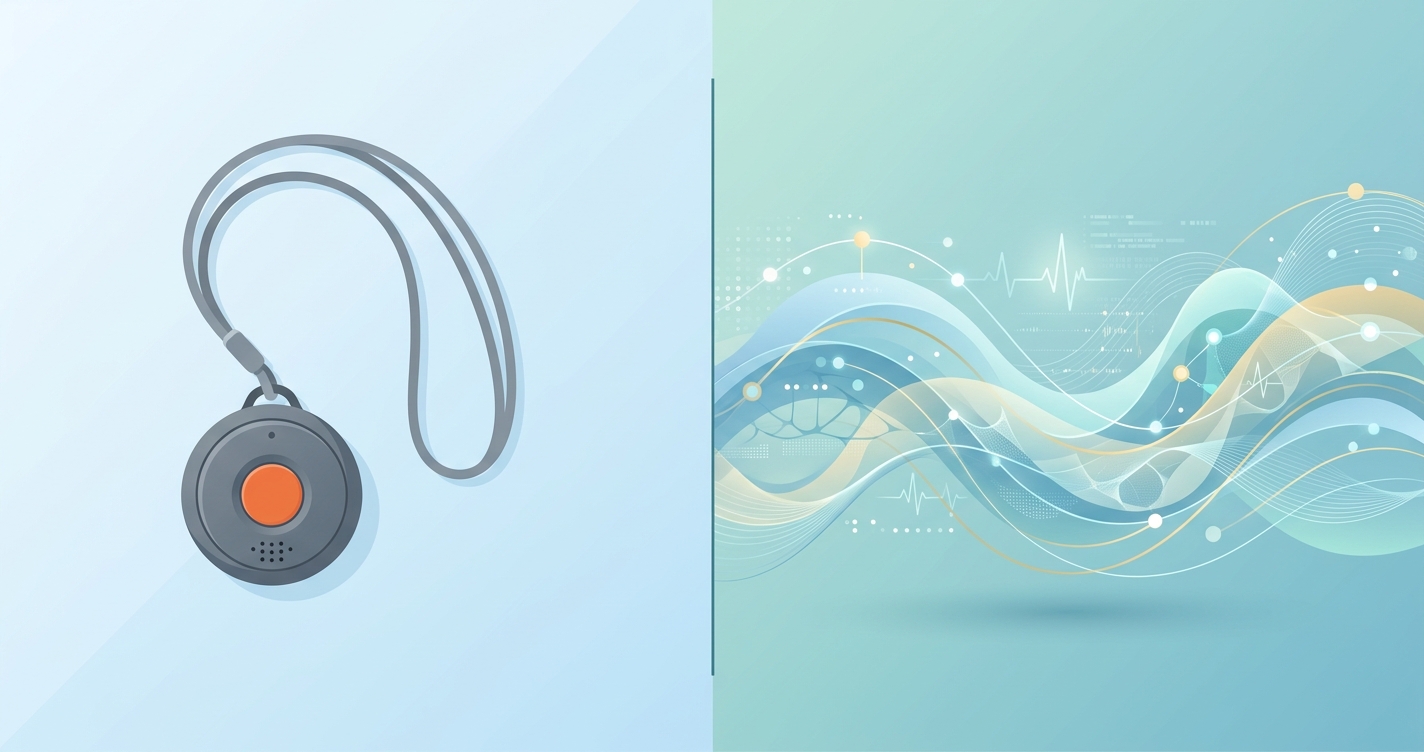
When an older adult chooses to age in place, family caregivers face a difficult balancing act between preserving independence and ensuring physical safety. As families and care providers research technology to support this transition, the decision often narrows down to a specific choice: medical alert vs remote monitoring. While these two categories of senior safety devices are sometimes conflated in consumer marketing, they operate on entirely different clinical and practical principles. One waits for an emergency to occur; the other tracks physiological data to identify risks before an emergency happens. Understanding the structural differences between these technologies is the first step in building a sustainable care plan for an aging parent or a facility resident.
"In up to 80 percent of falls where older adults are left on the floor for over an hour, manually activated medical alarms are never pressed, highlighting the critical gap between possessing a safety device and actually utilizing it during a crisis."
- Fleming and Brayne, British Medical Journal (2008)
The core difference: reactive responses vs. proactive health insights
Understanding the difference between a medical alert vs remote monitoring system requires looking at how the technology interacts with the older adult. Medical alert systems, often referred to as Personal Emergency Response Systems (PERS), are fundamentally reactive. They consist of wearable pendants, wristbands, or wall-mounted buttons designed to connect the user to a dispatch center. The primary utility of a medical alert device is rapid communication after an adverse event has already taken place.
Remote health monitoring takes a proactive approach. Instead of waiting for a user to report a crisis, these systems continuously track physiological data, such as respiratory rate, heart rate, or ambient movement. The goal of remote monitoring is to establish a baseline of normal health for the senior and identify deviations from that baseline. A gradual increase in resting heart rate or a subtle change in nighttime breathing patterns can indicate an impending health issue days before a medical emergency occurs.
By focusing on continuous data collection rather than episodic crisis intervention, remote monitoring systems provide family caregivers and clinical teams with a clearer picture of an older adult's overall trajectory.
Head-to-head comparison: medical alert vs remote monitoring
Families and care operators evaluating aging in place technology must weigh the specific benefits of each approach. The table below outlines the primary distinctions between the two models.
| Feature | Medical Alert Systems | Remote Health Monitoring |
|---|---|---|
| Primary Function | Emergency dispatch and communication | Continuous tracking of health data |
| User Action Required | High (must press a button or wear a device) | Low to None (often operates passively) |
| Data Type | Binary (safe or emergency) | Trending (vital signs, sleep, activity) |
| Emergency Focus | Post-incident response | Pre-incident risk identification |
| Adherence Reliance | Requires consistent user compliance | Functions independently of user memory |
| Caregiver Visibility | Notified only during an active alert | Access to daily health dashboards |
Why traditional panic buttons show high rates of non-adherence
The traditional medical alert pendant has been the standard for senior safety for decades. However, reliance on manual activation presents significant clinical and practical challenges. Research consistently demonstrates that older adults frequently fail to use these devices when they need them most.
The reasons for this non-adherence are complex and deeply tied to the psychology of aging:
- Stigma and Pride: Many seniors refuse to wear a visible pendant because they feel it signals frailty or a loss of independence to their peers.
- Cognitive Decline: Individuals with dementia or mild cognitive impairment may not remember what the button is for, or they may forget to press it during the disorientation of a fall.
- Physical Limitations: In the event of a severe fall, a stroke, or a cardiac event, the user may be physically incapable of reaching or pressing the button.
- Device Maintenance: Wearable alerts require regular charging. Seniors often take them off to charge them or to bathe, which are prime times for falls to occur.
- Fear of Inconveniencing Others: Published studies show that some seniors remain on the floor after a fall because they do not want to bother emergency services or worry their families over what they perceive as a minor incident.
When an older adult removes a wearable device, the protective value of the system drops to zero. This compliance gap is driving the senior care industry toward passive solutions that do not require the older adult to change their daily habits.
Industry applications: scaling care beyond the alert
Professional care organizations are increasingly moving away from basic panic buttons in favor of comprehensive tracking systems. The transition is driven by the need to manage larger populations of older adults with higher acuity levels.
Home health agencies
Home health agencies are operationally constrained by staffing shortages and travel times. A medical alert button tells an agency when a patient is headed to the hospital, but it does nothing to prevent the transfer. Remote health monitoring provides agencies with daily vital sign trends without requiring an in-person visit. Nurses can review patient dashboards each morning, prioritize visits for individuals showing physiological decline, and intervene before a costly hospital readmission becomes necessary.
PACE Programs
Programs of All-Inclusive Care for the Elderly (PACE) assume full financial and clinical risk for their participants. Because PACE programs are financially penalized for avoidable hospitalizations, they require technology that offers early warning signs. By implementing continuous remote monitoring, PACE interdisciplinary teams can track subtle shifts in respiratory or cardiac function, allowing them to dispatch a care provider to the home for a preemptive check-in.
Senior living and assisted living operators
Assisted living communities are managing residents who would have historically been placed in skilled nursing facilities. Relying solely on pull cords or wearable buttons leaves operators vulnerable to missed incidents. By integrating continuous monitoring into resident rooms, operators can track nighttime vitals and restlessness. This data allows facility directors to adjust care plans, optimize staff rounds, and demonstrate a higher standard of care to prospective families.
Current research and evidence
The academic consensus is shifting toward continuous, non-intrusive monitoring as the most effective method for supporting aging adults. A 2021 survey conducted by AARP found that 77 percent of adults over the age of 50 want to remain in their homes as they age. To make this preference a reality, researchers are evaluating technologies that bypass the limitations of wearables.
A 2023 study published in the journal MDPI explored the use of low-cost wireless sensor networks for non-invasive monitoring of older adults. The researchers concluded that continuous tracking of vital signs provides a more accurate representation of a patient's health status than intermittent spot checks, directly impacting sleep quality assessments and overall home safety.
Furthermore, researchers at the University of Alberta (2022) examined the efficacy of fall detection wearables, noting that even advanced accelerometers fail to capture certain types of slow falls or sliding descents. The study highlighted the need for ambient, room-based sensors that rely on environmental data rather than user-worn hardware to detect anomalies in movement and posture.
The transition from reactive to proactive care is rooted in the physiological reality that health emergencies are rarely sudden. Acute events, such as falls or respiratory failures, are frequently preceded by days of subtle physiological changes. Continuous data capture is the only way to observe these leading indicators.
The future of senior safety devices
The future of aging in place technology is ambient and invisible. As artificial intelligence and sensor technologies advance, the burden of safety will shift entirely away from the older adult. We are moving toward an era where the home itself acts as the primary health monitor.
Future systems will rely on contactless technology to track heart rate, respiration, and movement without requiring the senior to wear a device, press a button, or stand on a scale. Camera-based algorithms and ultra-wideband radar will analyze micro-movements in the environment to calculate vital signs continuously. This approach eliminates the stigma associated with medical alerts and solves the adherence problem permanently. If the senior does not have to interact with the device, they cannot forget to use it.
For families, this means checking a smartphone app to see that a parent is breathing normally in bed, rather than waiting in fear for a phone call from an emergency dispatcher. The technology will operate quietly in the background, providing peace of mind through verifiable data rather than just the promise of an alarm.
Frequently asked questions
What is the main difference between medical alert vs remote monitoring? Medical alert systems are reactive devices designed to summon help after an emergency has occurred, requiring the user to press a button. Remote health monitoring is proactive, continuously tracking health data like vital signs to identify potential issues before they become emergencies.
Why do seniors refuse to wear medical alert pendants? Many older adults refuse to wear pendants due to the perceived stigma, feeling that the device signals a loss of independence. Others may find them physically uncomfortable, or simply forget to put them back on after bathing or charging.
Can remote monitoring replace a medical alert button? For seniors who consistently refuse to wear a button or have cognitive limitations that prevent them from using one effectively, passive remote monitoring is often a safer alternative. It provides continuous oversight without relying on the senior's compliance.
Do remote monitoring systems require a Wi-Fi connection? Most modern remote health monitoring systems require an internet connection to transmit data to caregivers or clinical teams. However, many enterprise systems use built-in cellular connections to ensure continuous operation without relying on the home's residential Wi-Fi.
For organizations looking to move beyond traditional reactive buttons, Circadify is addressing this space with solutions designed to integrate continuous, contactless data into existing care models. To learn how proactive tracking can support higher acuity care in the home, explore how operators are utilizing the technology at circadify.com/solutions/hospital-at-home.