Is there a way to monitor my dad's heart rate all day without him wearing a device?
A research look at senior remote monitoring through contactless cameras that track heart rate all day without wearables, buttons, or compliance struggles.
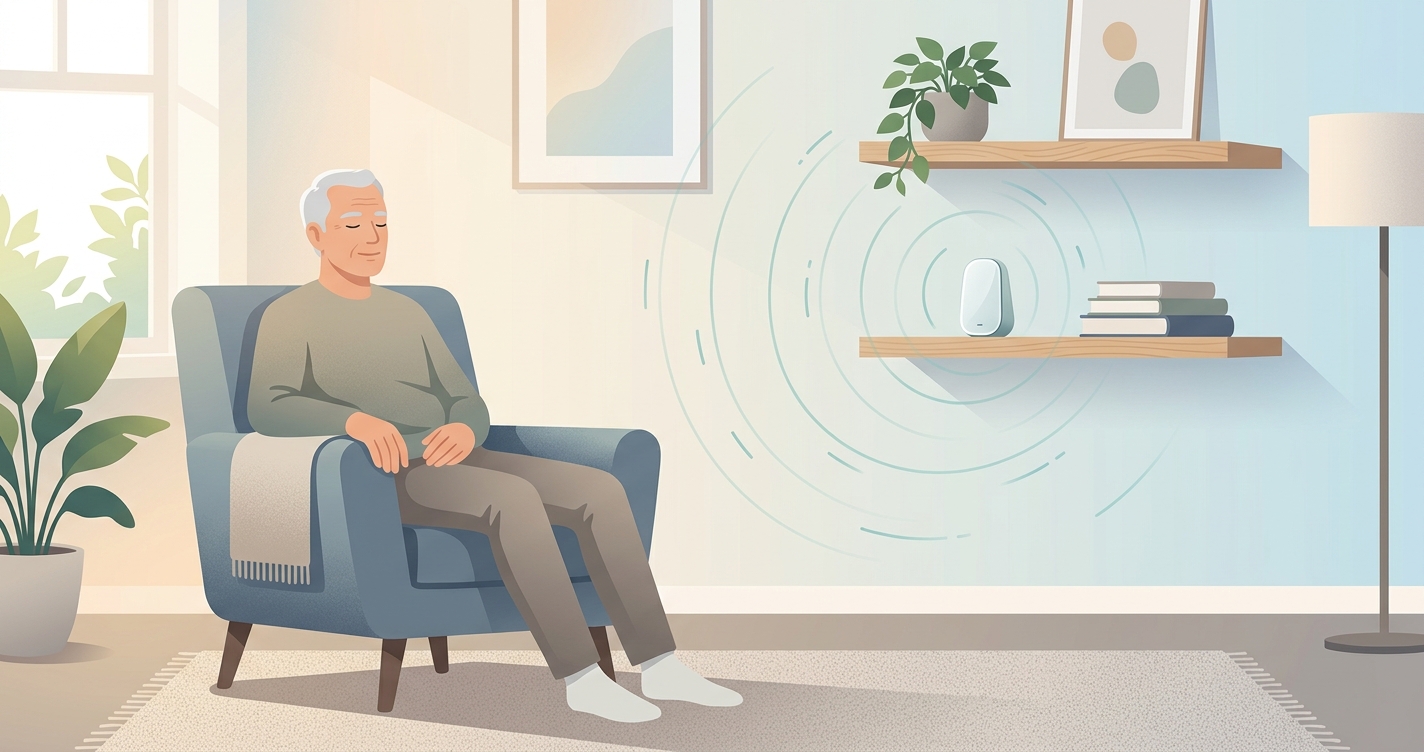
If you have ever bought your father a fitness watch only to find it sitting in a drawer two weeks later, you already understand the central problem with monitoring an older adult's heart rate. The technology to measure pulse continuously has existed for years, but it depends on something fragile: a person remembering to wear, charge, and tolerate a device every single day. For many seniors, that dependency breaks down quickly. This is where senior remote monitoring is shifting away from wearables entirely and toward passive, camera-based methods that collect heart rate data without asking your dad to do anything at all.
The compliance gap is not a minor inconvenience. It is the reason most home monitoring efforts quietly fail. A device that is not worn produces no data, and gaps in data are exactly when health changes go unnoticed.
"One-third of American consumers who buy a wearable device stop using it within six months," reported Endeavour Partners in its widely cited consumer wearables study, a finding later echoed by a 2016 Gartner survey showing roughly 30 percent of fitness trackers are abandoned by their owners.
Why senior remote monitoring is moving beyond wearables
The promise of a wrist-worn tracker is continuous data. The reality, especially for older adults, is intermittent data interrupted by dead batteries, skin irritation, forgotten charging, and simple resistance to wearing something unfamiliar. For a senior with mild cognitive decline, the daily ritual of putting on and charging a device is often the first thing to slip.
Senior remote monitoring built around contactless measurement removes the human compliance step. The dominant method is remote photoplethysmography, usually shortened to rPPG. An ordinary RGB camera detects the tiny color changes in facial skin that happen each time the heart pumps blood through surface capillaries. Software isolates that signal and converts it into a pulse rate. There is nothing to wear, charge, or remember. Your dad simply lives in his space while a discreet sensor observes from across the room.
The accuracy of this approach has improved substantially. A 2023 clinical validation of rPPG software in cardiovascular disease patients found strong agreement between camera-derived pulse rate and ECG, with a mean absolute error of about 1.06 beats per minute. Smartphone-based rPPG applications have reported heart rate accuracy above 97 percent against certified reference devices in controlled conditions.
The table below frames the practical trade-offs a caregiver or agency weighs when choosing how to track a parent's heart rate over a full day.
| Monitoring approach | Daily compliance required | All-day coverage | Comfort for senior | Typical failure point |
|---|---|---|---|---|
| Wrist wearable | High (wear + charge daily) | Partial, interrupted | Low to moderate | Device removed or uncharged |
| Chest strap or patch | High | Short sessions only | Low | Skin irritation, refusal |
| Manual pulse checks | High (caregiver present) | None, snapshots only | Moderate | Caregiver availability |
| Contactless camera (rPPG) | None | Continuous in-view | High | Lighting, line of sight |
A few patterns stand out when you compare these options side by side:
- Every wearable approach concentrates its weakness in the same place: it needs the senior, or a caregiver, to act every day.
- Manual checks produce only isolated snapshots, missing the overnight and between-visit hours where many changes begin.
- Contactless methods move the burden off the person and onto the environment, which is far more reliable than human routine.
- The main limitation of camera-based monitoring is environmental, not behavioral, which is generally easier to control in a home.
Industry applications for passive heart rate monitoring
Family Caregivers
For an adult child managing a parent from across town or across the country, the appeal is straightforward. A passive sensor reports resting heart rate trends without a single phone call asking, "Did you wear your watch today?" Instead of nagging, the caregiver receives consistent data and can intervene when a trend drifts rather than waiting for a crisis. This preserves the parent's dignity while closing the visibility gap that distance creates.
Home health agencies
Home health agencies face staffing shortages and rising patient acuity at the same time. Nurses cannot be present around the clock, and patients between visits represent a blind spot. Contactless senior remote monitoring fills that interval with objective heart rate trends that inform visit scheduling and clinical triage. Because there is no device for the patient to manage, agencies avoid the documentation and re-education burden that comes with wearable noncompliance.
Pace programs and senior living operators
Programs of All-Inclusive Care for the Elderly and senior living communities both manage large, high-needs populations where consistency matters more than peak precision. Passive monitoring scales without asking staff to chase down charging cables or replace lost devices. The data supports early identification of residents whose vitals are trending toward instability, which can reduce avoidable emergency transfers.
Current research and evidence
The evidence base for contactless heart rate measurement has matured from laboratory curiosity to clinical evaluation. The 2023 validation work in cardiovascular patients demonstrated that rPPG-derived pulse rate can track closely with ECG in real patient populations, not just healthy volunteers. Independent reviews of rPPG methods, including a comprehensive 2023 survey of estimation techniques, document the rapid adoption of deep learning models, particularly convolutional neural networks, to handle the messy conditions of real homes.
Researchers are candid about the limits. Studies note that rPPG accuracy can degrade with motion, poor or uneven lighting, large distances, and elevated heart rates. One 2023 analysis found that accuracy drops sharply at high heart rates, which matters less for resting trend monitoring in seniors than it would for athletic tracking. Skin tone and lighting variation also influence signal quality, an active area of algorithmic work aimed at equitable performance across populations.
The contrast with wearables remains instructive. The abandonment data is remarkably stable over time. The Endeavour Partners finding of one-third abandonment within six months, the Gartner figure near 30 percent, and other reports citing 42 percent loss of interest after six months all point to the same conclusion: hardware improvements have not solved the behavioral problem. As several analysts have observed, the issue is rarely device failure but data overload without a daily reason to keep wearing it. Passive monitoring sidesteps that question because there is nothing to abandon.
The future of senior remote monitoring
The direction of travel is toward monitoring that disappears into the background of a home. Several developments are likely to shape the next few years:
- Multi-vital extraction from a single camera feed, adding respiratory rate and movement patterns to heart rate, giving a fuller picture of daily stability.
- Edge processing that analyzes video locally and transmits only numerical trends, addressing the privacy concerns families reasonably raise about cameras.
- Trend-based alerting that flags meaningful deviations from a person's own baseline rather than generic thresholds, reducing false alarms.
- Tighter integration between passive home data and the workflows of home health nurses and PACE care teams, so a drifting heart rate trend triggers a coordinated response.
As accuracy in uncontrolled conditions continues to improve, the practical question for families shifts from whether passive monitoring is possible to how to deploy it thoughtfully and privately. The compliance-free model addresses the single biggest reason older adults stop being monitored at all.
Frequently asked questions
Can a camera really measure heart rate without touching my dad? Yes. Remote photoplethysmography uses an ordinary camera to detect subtle color changes in facial skin caused by each heartbeat. Clinical validation studies have shown close agreement with ECG, with errors near 1 beat per minute in controlled settings, though everyday accuracy depends on lighting and the person staying in view.
Why not just buy him a smartwatch? Smartwatches only work when worn and charged. Research consistently shows roughly one-third of users abandon wearables within six months, and the rate of disuse is often higher among older adults who find daily charging and wearing burdensome. A device in a drawer produces no data.
Is contactless monitoring accurate enough to be useful? For tracking resting heart rate trends over a day, the accuracy is well suited. Studies note that precision can decline with motion, dim lighting, or very high heart rates, but for spotting day-over-day changes from a senior's own baseline, trend consistency matters more than single-reading precision.
What about privacy with a camera in the home? This is a legitimate concern. The most privacy-conscious systems process video locally and transmit only numerical vital sign trends rather than storing or sending raw footage. Families should ask any provider exactly what is recorded, where it is stored, and who can access it.
Circadify is building toward this future of passive, comfortable senior remote monitoring, where consistent heart rate data is gathered without a wearable, a button, or a daily compliance battle. Families and home health agencies looking to close the visibility gap between visits can explore the approach through Circadify's senior care program at circadify.com/solutions/hospital-at-home.