What if my independent mother needs help, but can't reach a button?
Passive non-intrusive elderly care can detect distress when a senior cannot press an alert button. A research look at why buttons fail and what replaces them.
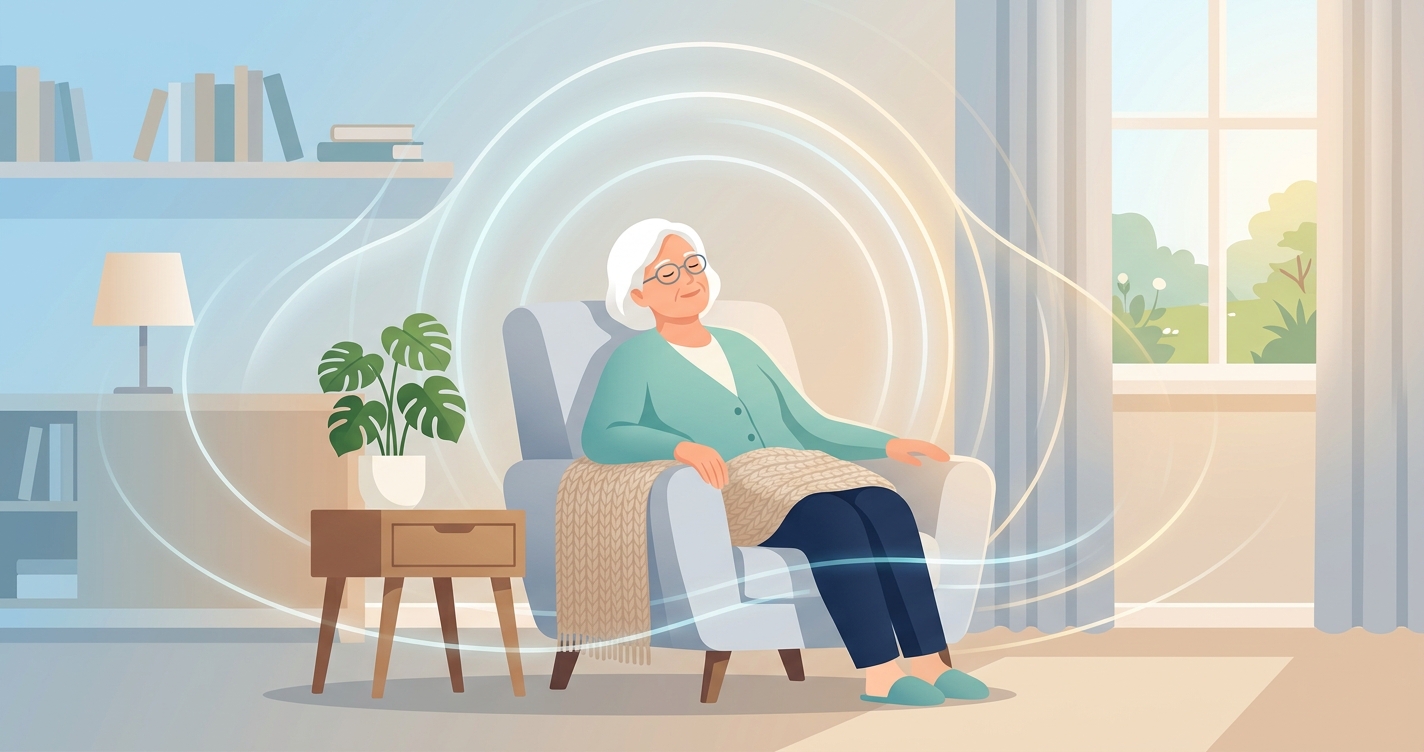
The promise of the help button is simple: press it, and rescue arrives. The reality is far more fragile. A button only works if a person is conscious, oriented, physically able to reach it, and actually wearing it at the moment a crisis unfolds. For an independent mother who has chosen to stay in her own home, those four conditions fail more often than most families realize. This gap is exactly where non-intrusive elderly care has become a serious area of study, because the most dangerous emergencies are frequently the ones a senior cannot announce.
Consider the most common scenario families fear. A fall happens in the bathroom or hallway, the pendant is on the nightstand or in a drawer, and the person is too disoriented, injured, or weak to crawl to a phone. The emergency is real, but the alert never comes.
In a study of monitored older adults who fell while alone and remained on the floor for more than five minutes, 83% did not activate their personal emergency response system. Among community-dwelling adults over 90 who fell, roughly 80% could not get up without help, and 30% experienced a "long lie" of more than an hour on the floor.
Why buttons fail and where non-intrusive elderly care fits
The core weakness of any push-button system is that it depends on the victim to function as the sensor. Research on personal emergency response systems (PERS) consistently shows a compliance and capability problem. Studies cited in reviews of PERS use have found that only about 14% of subscribers wear their device 24 hours a day, while roughly 24% never wear it at all. Even among those who do wear it, the button is pressed in only about half of actual fall events. The device is most useful in precisely the situations where the user is least able to use it.
Non-intrusive elderly care reframes the problem. Instead of asking the senior to recognize an emergency and take action, passive monitoring observes the environment continuously and flags abnormal patterns on its own. The senior does nothing. There is no pendant to charge, no button to remember, and no decision to make in a moment of panic or confusion.
The clinical stakes are well documented. A "long lie," generally defined as remaining on the floor for more than one hour after a fall, is associated with dehydration, pressure injuries, pneumonia, rhabdomyolysis, and a sharply elevated risk of hospitalization and long-term care placement. Reducing the time between an incident and a response is one of the few variables that meaningfully changes outcomes, and it is the variable a button is worst at controlling.
Here is how the main approaches compare on the factors that matter most to families and operators.
| Approach | Requires action from senior | Works if unconscious | Wearable burden | Continuous coverage | Detects gradual decline |
|---|---|---|---|---|---|
| Push-button PERS | Yes | No | Pendant or wristband | No, only when pressed | No |
| Automatic wearable fall detection | No | Partial | Pendant or watch | Only while worn and charged | Limited |
| Radar or sensor passive monitoring | No | Yes | None | Yes | Yes |
| Camera-based passive monitoring | No | Yes | None | Yes | Yes |
The pattern is clear. The systems that ask the least of the senior are the ones most likely to catch the emergency she cannot report herself.
What passive systems actually watch for
Non-intrusive monitoring does not rely on a single dramatic event. It builds a picture of normal and notices when reality drifts away from it. The signals that matter include:
- Sudden posture changes consistent with a fall, followed by a prolonged period of stillness on the floor.
- Absence of expected movement, such as a person who normally rises by 7 a.m. but has not stirred.
- Changes in gait, balance, or how long it takes to move between rooms.
- Disruptions in sleep, breathing rate, or heart rate measured contactlessly.
- Deviations from daily routines like meals, bathroom use, or time spent in a chair.
The distinction between acute and gradual detection is important. A button can only ever address the acute moment, and only if pressed. Passive systems address both the sudden fall and the slow slide that precedes many crises. A senior who is becoming dehydrated, developing an infection, or experiencing a medication reaction often shows subtle behavioral and physiological changes for days before a collapse. Catching that trend is a form of prevention a button can never offer.
Industry Applications
Family Caregivers
For adult children managing care from a distance, the value of non-intrusive elderly care is the removal of dependence on a parent's cooperation. Many seniors resist wearing a pendant because it feels like a symbol of frailty, or they simply forget. Passive monitoring respects the parent's autonomy while giving the family a reliable safety net. The goal is not surveillance of every moment but confirmation that the normal rhythm of the day is intact, with an alert only when it is not.
Senior living and assisted living operators
Operators face rising resident acuity and persistent staffing shortages. Passive monitoring extends the reach of limited night-shift staff by flagging the apartments that need a check rather than requiring scheduled rounds on every unit. It also addresses a liability reality: when a resident falls and cannot summon help, the question of how long they waited becomes central. Continuous passive detection shortens that interval and creates a documented response record.
Pace programs and home health agencies
PACE programs carry full clinical and financial risk for their participants, which makes avoidable hospitalizations especially costly. Home health agencies operate under intermittent visit schedules, leaving long gaps between in-person contact. In both models, passive monitoring fills the time between human touchpoints, surfacing the deterioration that would otherwise be discovered only at the next visit or in the emergency department.
Current research and evidence
The technical foundation for passive detection has matured quickly. A 2024 survey of radar-based fall detection published through the National Institutes of Health literature documented systems achieving fall detection accuracy around 95% and posture classification accuracy near 98.66%, while preserving privacy because radar captures no visual image. Radar can sense presence, motion, posture, and even micro-movements such as breathing, and it functions in darkness and through minor obstructions.
Contactless vital sign measurement has progressed in parallel. A digital health technology evaluation study published in JMIR mHealth and uHealth reported reliable contactless monitoring of heart rate, breathing rate, and breathing disturbance during sleep in aging adults, demonstrating that physiological signals can be captured without any device on the body. A broader 2024 review in Sensors and Diagnostics surveyed the field of remote health sensing for heart rate and respiration, confirming a growing evidence base for camera and sensor-based vital sign capture.
The research consensus on falls reinforces why this matters. Work compiled in scoping reviews on the "long lie" phenomenon, including studies from the University of Sheffield, links time-on-floor directly to worse clinical outcomes. When the literature on PERS non-activation is read alongside the literature on long-lie consequences, the conclusion is difficult to avoid: a meaningful share of the worst outcomes stem not from the fall itself but from the delay in response that a button-dependent model cannot prevent.
The future of non-intrusive elderly care
The trajectory points toward layered, ambient systems that combine multiple passive signals rather than relying on any single sensor. Expect three developments to define the next phase:
- Multi-modal fusion, where movement, vital signs, and routine data are interpreted together to reduce false alarms and improve confidence in genuine emergencies.
- Predictive alerting that flags rising risk before an acute event, shifting the model from rescue toward prevention.
- Privacy-forward design, with on-device processing and abstracted data that protect dignity while still informing caregivers.
As these systems integrate with care coordination workflows, the button will not disappear entirely, but it will be reframed as one option among many rather than the primary line of defense. The center of gravity is moving toward monitoring that works whether or not the senior can ask for help.
Frequently asked questions
What happens if my mother falls and is unconscious or can't reach a button?
This is the central limitation of any push-button system, since it requires the user to be conscious, capable, and wearing the device. Passive non-intrusive monitoring is designed for exactly this case, detecting a fall and prolonged stillness on its own and alerting a caregiver without any action from your mother.
Is passive monitoring an invasion of my parent's privacy?
Well-designed systems prioritize dignity by processing data locally and sharing patterns and alerts rather than constant raw footage. Radar-based approaches capture no visual image at all, and the intent is to confirm safety and flag exceptions, not to watch every moment of daily life.
Does my parent have to wear or operate anything?
No. The defining feature of non-intrusive elderly care is that it places no burden on the senior. There is nothing to wear, charge, or remember, which is what makes it effective for people who resist or forget pendants.
Can passive monitoring catch problems beyond falls?
Yes. Beyond acute events, these systems track gradual changes in movement, sleep, breathing, and routine that often precede a health crisis, giving caregivers a chance to intervene before an emergency develops.
Circadify is building toward this future of non-intrusive elderly care, with daily passive health checks that work without wearables or buttons. To see how continuous, contactless monitoring fits into a coordinated senior care program, explore the hospital-at-home solution.