How can I prevent my 90-year-old father from falling when I'm not there?
Senior remote monitoring can detect subtle gait and activity changes that precede falls, giving family caregivers early warning and peace of mind from a distance.
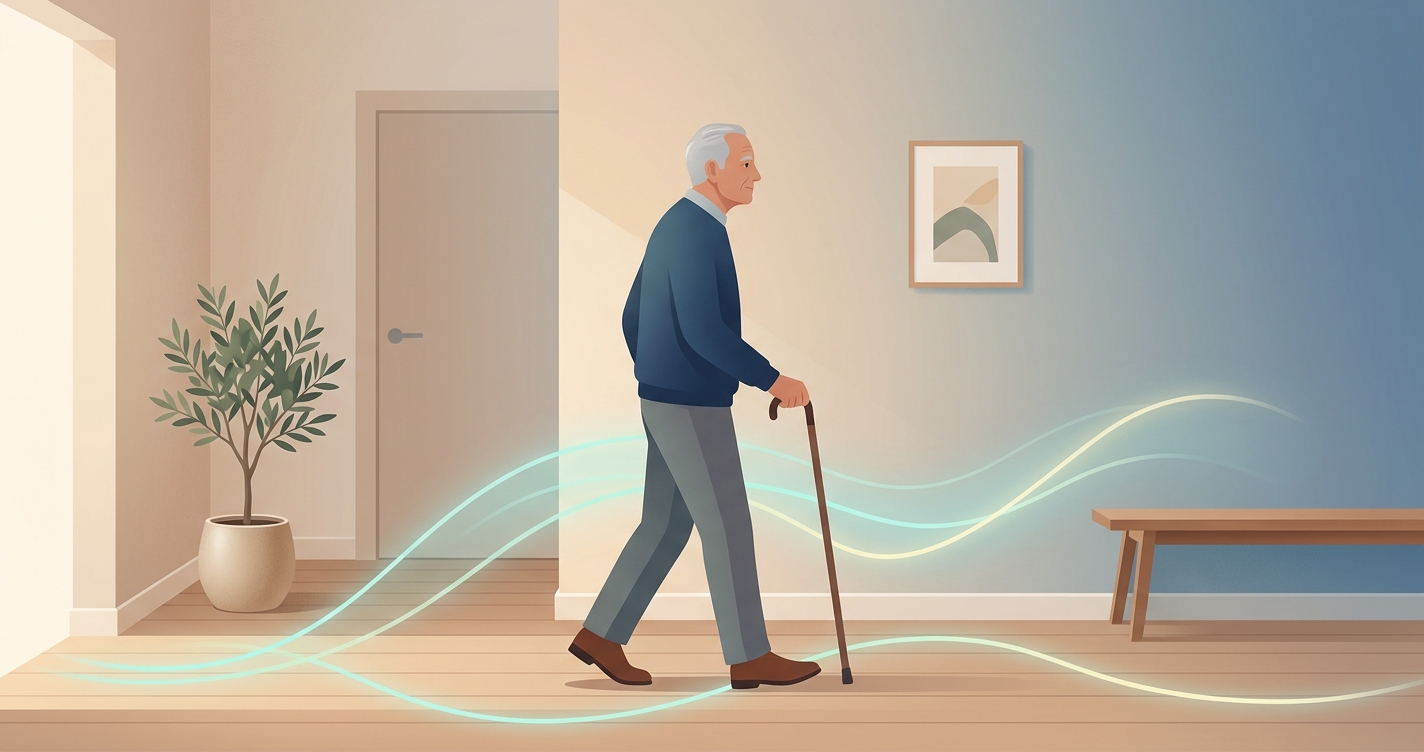
Watching a 90-year-old parent live alone introduces a specific kind of worry, one that tends to peak in the hours you cannot physically be present. The fear is rarely abstract. It is the image of a fall in the hallway at 2 a.m., the phone that goes unanswered, the long wait until someone discovers what happened. For decades, the only answers families had were reactive: a pendant to press after a fall, a daily check-in call, or a move into a facility. A more useful question is whether the conditions that lead to a fall can be spotted before the fall occurs. This is the premise behind senior remote monitoring, and the research now suggests that many falls are not random events but the visible end of a measurable decline.
A decline in gait speed of just 5 centimeters per second was associated with an 86.3 percent probability of falling within the following three weeks, according to in-home sensor research led by Marjorie Skubic and Marilyn Rantz at the University of Missouri.
What senior remote monitoring actually detects
The core insight driving senior remote monitoring is that falls have a runway. Before an older adult goes down, their body usually signals trouble through changes that are too small for a once-a-month visit to catch. Walking slows. Stride shortens. Time spent in bed increases. Trips to the bathroom at night become more frequent or more hesitant. Each of these shifts is minor on its own, but tracked continuously over weeks, they form a trend line that points toward elevated risk.
The Missouri work is instructive because it quantified these patterns. The team installed unobtrusive sensors, including pulse-Doppler radar and depth cameras, in the apartments of residents at TigerPlace, an aging-in-place residence in Columbia, Missouri. The system measured gait speed and stride length passively, with no device for the resident to wear or remember. Beyond the gait speed finding above, the researchers reported that a shortened stride length carried roughly a 50.6 percent probability of a fall within three weeks. When the system detected these changes, it sent alerts to nurses, who could intervene before the fall happened.
For a family caregiver, the takeaway is direct. The goal is not to be standing in the room when your father stumbles. The goal is to know, two or three weeks earlier, that his walking has slowed enough to warrant a call, a medication review, or a physical therapy referral.
Comparing approaches to fall safety at home
Not all fall-related technology does the same job. The distinction that matters most is whether a tool reacts after a fall or flags risk before one. The table below compares the common categories families encounter.
| Approach | When it acts | Caregiver effort | Requires senior to do something | Detects risk before a fall |
|---|---|---|---|---|
| Emergency pendant or button | After the fall | Low | Yes, must press it | No |
| Wearable fall detector | During or after the fall | Low to medium | Yes, must wear and charge it | Limited |
| Daily check-in calls | Reactive, point in time | High | Yes, must answer | No |
| Senior remote monitoring (passive sensors or camera) | Before the fall, trend-based | Low | No | Yes |
| In-facility supervision | Continuous | Outsourced | No | Partial |
The pattern is clear. The tools that demand the least from a 90-year-old, and that work even when he forgets, are the passive ones. A pendant only helps if it is worn and the wearer is conscious enough to press it. A monitoring system that watches gait and activity in the background asks nothing of him at all.
Key considerations when evaluating options:
- Adherence: Devices that must be worn or charged are frequently abandoned, especially among the oldest adults.
- Privacy: Passive systems vary widely; some use radar or motion sensors, others use cameras that process data without storing raw video.
- Lead time: The practical value is in the warning window, the days or weeks of notice that allow a preventive response.
- Caregiver workload: A system that pushes a clear alert beats one that produces raw data a family member must interpret daily.
Industry applications of remote monitoring
Family caregivers managing from a distance
For adult children who live in another city or state, senior remote monitoring converts a constant low-grade anxiety into a defined signal. Instead of calling three times a day to confirm a parent answered, the caregiver receives an alert only when a trend deviates from baseline. The 3.85 million older adults treated in emergency departments for falls in 2023, reported by the CDC, represent millions of families who learned about a problem only after the ambulance arrived. Trend-based monitoring aims to move that notification earlier.
Home health agencies and PACE programs
Agencies and Programs of All-Inclusive Care for the Elderly operate under financial pressure to prevent avoidable hospitalizations. Continuous gait and activity data gives clinical staff a way to prioritize visits, sending a nurse or therapist to the participant whose walking speed dropped this week rather than relying on a fixed visit schedule. This is risk stratification applied to the home.
Senior living operators
Independent and assisted living communities use passive monitoring to extend the reach of limited staff. Rather than hourly rounds, operators can focus attention on residents whose data shows emerging instability, documenting the proactive response for families and regulators alike.
Current research and evidence
The Missouri sensor program remains one of the most cited demonstrations that fall risk is detectable in advance, but the broader literature supports the underlying mechanism. A 2023 systematic review and meta-analysis published in connection with gait research confirmed that gait variability is a significant predictor of falls in older adults, with increased variability in walking patterns associated with a higher likelihood of future falls. In plain terms, it is How fast someone walks. How consistently they walk that signals danger.
The scale of the problem explains the research intensity. The CDC reported that more than 41,000 Americans aged 65 and older died from falls in 2023, with a death rate of 69.9 per 100,000, and that the rate for those 85 and older has more than doubled since 2003. Roughly one in four older adults reports falling each year. On the cost side, healthcare spending for non-fatal falls reached an estimated 80 billion dollars in 2020, with projections approaching 101 billion dollars by 2030.
What the evidence does not yet promise is perfect prediction for any single individual. The studies describe probabilities across populations, and a personalized baseline takes time to establish. The practical message for a caregiver is that monitoring shifts the odds, surfacing risk earlier than human observation alone, rather than guaranteeing that no fall will ever occur.
The future of senior remote monitoring
The direction of the field is toward systems that are increasingly invisible and increasingly interpretive. Three shifts are underway:
- From detection to prediction: Early products announced that a fall had happened. Newer approaches forecast the elevated-risk window so intervention can occur first.
- From wearables to ambient sensing: The recognition that the oldest and highest-risk adults are the least likely to wear devices is pushing development toward camera and sensor systems that require nothing of the resident.
- From raw data to actionable alerts: As analysis improves, the burden of interpreting trends moves off the family member and onto the system, which delivers a plain-language flag when something changes.
For a family weighing how to keep a 90-year-old father safe, the trajectory is encouraging. The technology is moving toward exactly what caregivers have always wanted: advance notice, without asking an aging parent to change a single habit.
Frequently asked questions
Can monitoring actually prevent a fall, or just alert me after one? The most useful systems aim to do both, but their distinct value is in prevention. By tracking gait speed, stride length, and activity over time, they flag the rising risk that often precedes a fall by days or weeks, giving you a window to act with a medication review, a therapy referral, or a home safety change.
Does my father have to wear or operate anything? Not with passive senior remote monitoring. Camera-based and sensor-based systems run in the background and measure movement without any device to charge, wear, or press. This matters because adherence to wearables is low among the oldest adults, who are also at highest risk.
How much advance warning does monitoring provide? Research from the University of Missouri found that specific gait changes were associated with a high probability of falling within three weeks. Individual results vary and a personal baseline takes time to build, but the practical benefit is a lead time that human observation rarely offers.
Is camera-based monitoring an invasion of my father's privacy? Privacy design varies by system. Many process movement and vital sign data without storing raw video, focusing on trends rather than continuous footage. Reviewing how a given system handles and stores data should be part of any evaluation.
Circadify is building toward this proactive model of care, applying non-intrusive daily health checks so families and providers can act on subtle changes before a fall occurs rather than after. To see how this approach fits a senior care program, explore the work underway at circadify.com/solutions/hospital-at-home.