How can I understand my parent's health trends before a doctor's visit?
How aging in place technology turns continuous, non-invasive health data into clear trends families can review before a parent's next doctor's visit.
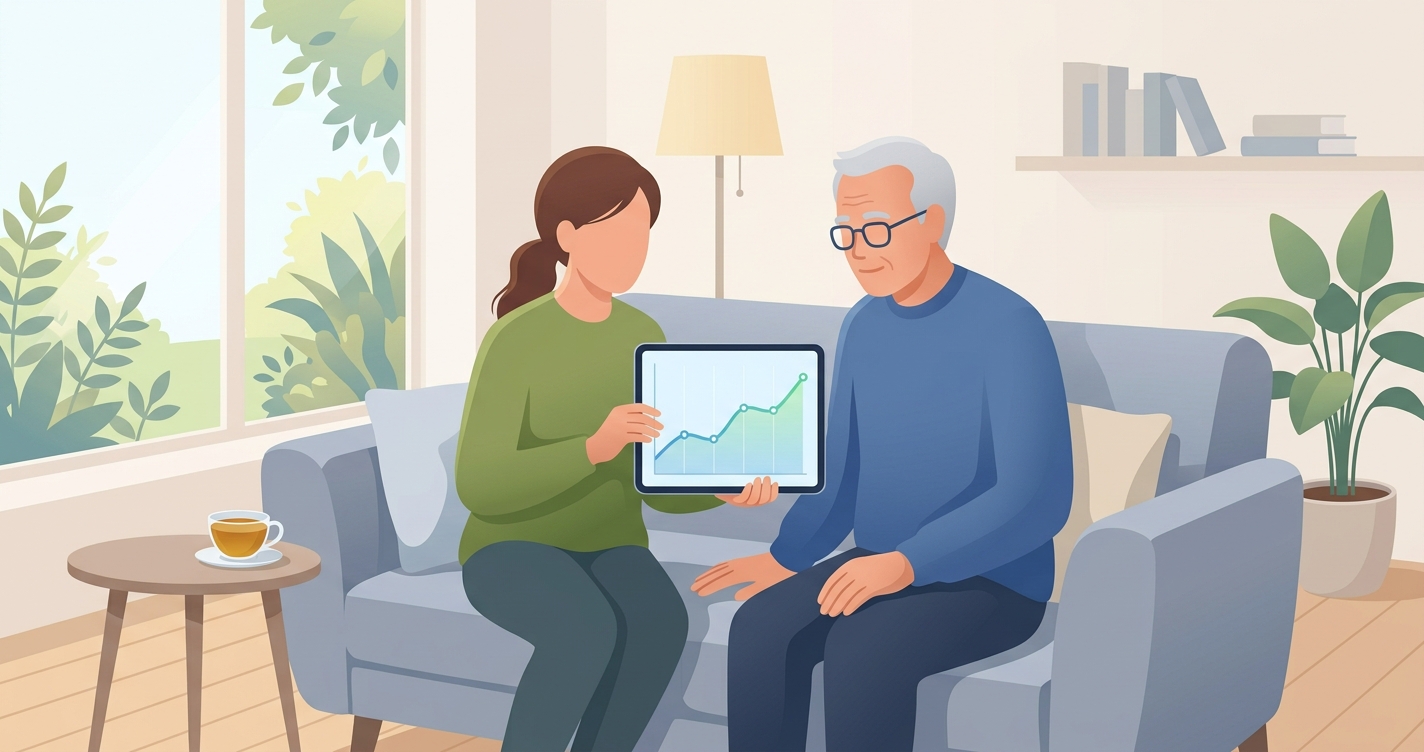
Most adult children walk into a parent's medical appointment armed with little more than a vague worry and a few anecdotes. The doctor asks how mom has been sleeping, whether her appetite has changed, or if her heart rate has been irregular, and the honest answer is usually a shrug. That gap between what a family observes during occasional visits and what a clinician needs to make decisions is exactly where aging in place technology has started to change the conversation. Continuous, non-invasive health data collected in the home gives caregivers something they have never had before: a record of how a parent is actually trending day to day, not just a snapshot from a single fifteen-minute office visit.
"The number of family caregivers helping older US adults increased from 18 million to 24 million between 2011 and 2022," report researchers Jennifer Wolff and colleagues at the Johns Hopkins Bloomberg School of Public Health in Health Affairs (2023). The same body of research shows roughly four in ten caregivers regularly help manage healthcare tasks such as scheduling appointments and tracking medications.
Why aging in place technology changes the pre-visit conversation
A doctor's visit is a moment of clinical inference. The provider takes a blood pressure reading, listens to the heart, asks questions, and tries to reconstruct weeks of life from that one encounter. The problem is well documented: a single reading captures a single point in time, often distorted by the stress of the appointment itself. White-coat hypertension, where blood pressure spikes in a clinical setting, is a classic example of how one measurement can mislead.
Aging in place technology addresses this by shifting measurement out of the clinic and into the place where seniors actually spend their time. Instead of one data point, a clinician receives a trend line. Was the resting heart rate creeping up over three weeks? Did respiratory rate change before a parent reported feeling unwell? Did sleep become fragmented in the days leading up to a fall? These patterns are invisible to episodic care but obvious in continuous data.
For family caregivers, the value is practical. You arrive at the appointment able to say, "Her overnight breathing rate has been higher than usual for the past ten days," rather than, "She seems a little off." That single shift turns a worried relative into an informed partner in care.
What continuous data actually reveals
- Direction, not just value. A heart rate of 78 means little in isolation. A heart rate that has climbed from 68 to 78 over two weeks is a signal worth discussing.
- Timing. Knowing that symptoms cluster at night or after medication changes helps a provider connect cause and effect.
- Baseline. Every senior has a personal normal. Continuous monitoring establishes that baseline so deviations stand out.
- Context for medication. Trends before and after a prescription change show whether the drug is working as intended.
Comparing how caregivers gather health information
The methods families use to understand a parent's health vary widely in how much they actually capture. The table below contrasts the common approaches against continuous, non-intrusive monitoring.
| Approach | Frequency of data | Burden on senior | Captures trends? | Useful before a visit? |
|---|---|---|---|---|
| Memory and phone calls | Occasional, subjective | None | No | Limited |
| Manual cuff or finger device | When remembered | Moderate, requires action | Partial | Somewhat |
| Wearable tracker | Continuous if worn | High, must charge and wear | Yes | Yes, if compliance holds |
| Periodic clinic readings | A few times a year | Low | No | Snapshot only |
| Non-intrusive camera-based monitoring | Daily, passive | None | Yes | Strong |
The pattern is clear. Approaches that demand action from the senior tend to fail over time because compliance drops, while passive methods that require nothing from the person produce the most consistent record. This is the core argument behind aging in place technology that works without wearables or buttons: the most reliable data is the data a senior does not have to remember to generate.
Industry applications for families and agencies
Family caregivers managing from a distance
Distance caregiving has become a permanent operating model rather than a temporary phase. With caregivers dedicating an average of more than three and a half hours per day to eldercare according to Bureau of Labor Statistics data, anything that reduces uncertainty has outsized value. A caregiver in another state can review a weekly trend summary, notice a gradual change, and decide whether to call the doctor now or wait. That triage ability prevents both unnecessary panic and dangerous delay.
Before an appointment, the same caregiver can export or summarize recent trends and bring concrete observations. Providers consistently report that they make better decisions when families arrive with specifics rather than impressions.
Home health agencies and care teams
For home health agencies, continuous data supports the clinical documentation and assessment work that drives reimbursement and quality scores. Nurses who visit intermittently gain visibility into the days between visits. When a clinician arrives, the visit becomes a response to known trends rather than a fresh investigation. This is especially relevant for agencies managing patients with multiple chronic conditions, where small changes compound quickly.
PACE programs and senior living operators
Programs that carry full financial and clinical responsibility for a population have the strongest incentive to catch problems early. Continuous monitoring lets care teams prioritize who needs attention this week, turning a reactive model into a proactive one. The same trend data that helps a family prepare for a doctor's visit helps an interdisciplinary team decide who to see first.
Current research and evidence
The evidence base for home-based monitoring of older adults continues to grow. A multicenter retrospective study published in the Journal of Medical Internet Research examined a home-based remote patient monitoring system for older adults with polypathology and found associations with reduced hospitalizations and emergency department visits. Systematic reviews indexed in MDPI journals on healthy aging with smart technologies similarly conclude that remote monitoring supports early anomaly detection and chronic disease management while helping seniors maintain independence.
The market data reflects this momentum. Industry analysts place the global remote patient monitoring market at roughly 14 billion dollars in 2023, with projections approaching 41.7 billion dollars by 2028 at an annual growth rate above 20 percent. On the demand side, AARP research shows that the overwhelming majority of older adults want to age in place, and a 2024 survey found that 95 percent of adults aged 55 and older consider aging in place an important goal, up from 93 percent the prior year.
What the research does not yet fully resolve is how to translate raw continuous data into clear, actionable summaries for non-clinical families. A trend line is only useful if a caregiver can interpret it. The next wave of work in this space focuses less on collecting more data and more on presenting it in a way that supports a real conversation with a doctor.
The future of aging in place technology
The direction of travel is toward measurement that disappears into the background of daily life. Wearables solved the continuity problem but introduced a compliance problem, since a device left on a nightstand collects nothing. The emerging generation of aging in place technology emphasizes passive, contactless sensing that asks nothing of the senior at all. A camera-based daily check that captures vital sign trends without contact, charging, or remembering to press anything removes the friction that causes most monitoring efforts to fail.
Three shifts are likely to define the next several years:
- From alerts to narratives. Rather than firing alarms, systems will summarize trends in plain language a family can bring to an appointment.
- From individual gadgets to integrated care. Data will flow into the same record clinicians and agencies already use, closing the gap between home and clinic.
- From reactive to predictive. As baselines accumulate, subtle deviations will flag concerns days before a person feels symptoms, giving families time to act.
The goal is not to replace the doctor's visit but to make it count. When a parent and a caregiver walk in with weeks of context instead of a single anxious anecdote, the appointment becomes a conversation about evidence rather than a guessing game.
Frequently asked questions
What kind of health trends can I actually track at home before a doctor's visit? Depending on the technology, families can track trends in resting heart rate, breathing rate, sleep patterns, and general activity. The value lies in the direction and consistency of these measures over days and weeks, which gives a provider far more to work with than a single in-office reading.
Do these tools require my parent to wear or do anything? Not always. Wearables require charging and consistent use, which often breaks down over time. Non-intrusive options such as camera-based daily checks collect data passively, which tends to produce a more complete record because the senior does not have to remember to participate.
Is home health data a replacement for seeing the doctor? No. Continuous monitoring is meant to inform the visit, not replace it. It helps families and clinicians arrive at the same conversation with shared, objective context so the appointment time is spent on decisions rather than reconstruction.
How do I present this data to a healthcare provider? Bring a simple summary of trends and any notable changes, along with their timing. Most providers respond well to concise observations such as a sustained change in a baseline measurement over a defined window, rather than raw numbers without context.
Circadify is building toward this future of non-intrusive, camera-based daily health checks for seniors, giving families and care teams the continuous context that makes every doctor's visit more productive. To see how this approach fits into a coordinated senior care program, explore Circadify's hospital-at-home solution.