How Memory Care Units Use Passive Health Monitoring
Memory care passive health monitoring helps operators track overnight vitals, sleep, and daily changes without asking residents with dementia to wear devices.
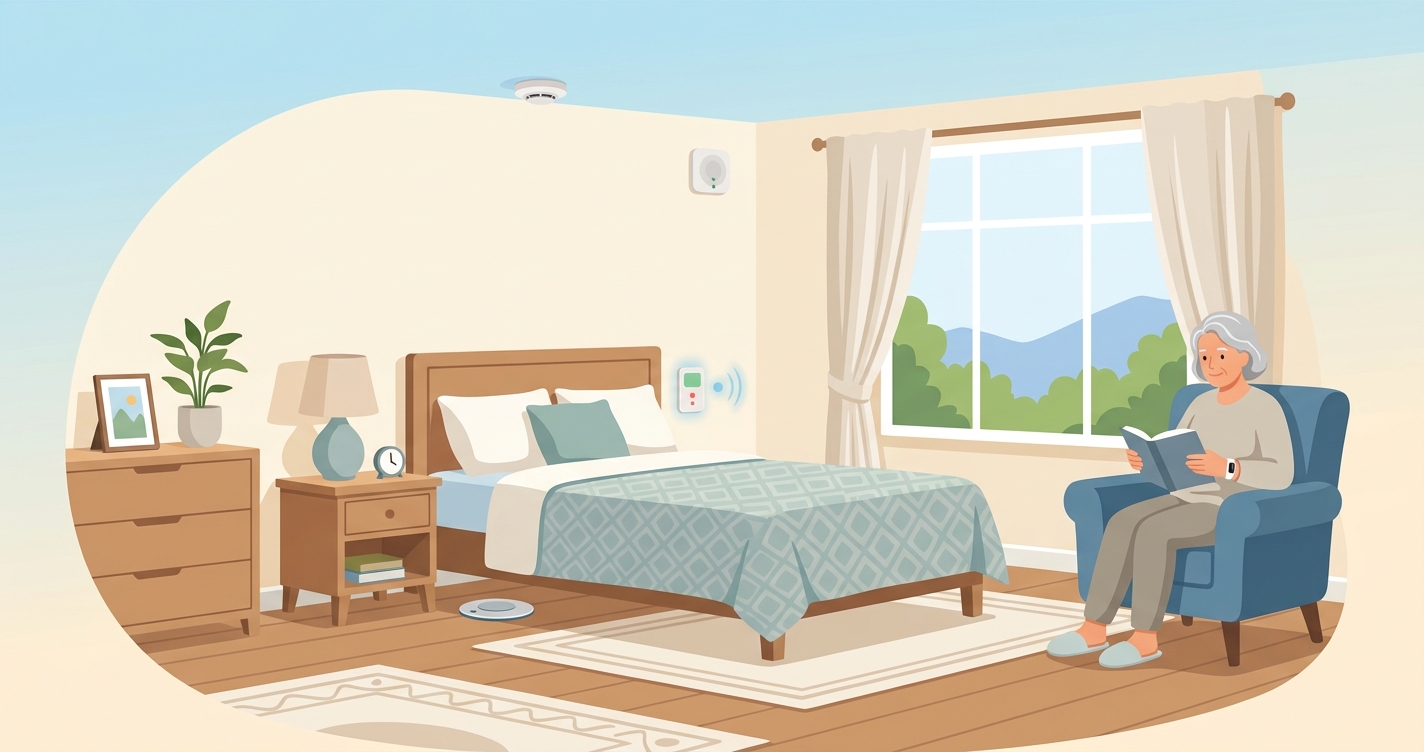
Memory care passive health monitoring is getting serious attention because dementia care has a compliance problem built into it. Many residents cannot reliably remember to charge a wearable, press a call button, explain symptoms clearly, or describe how last night felt. That leaves operators trying to detect decline from staff observation alone. In practice, the earliest clues often show up somewhere quieter: breathing changes overnight, more time in bed, disrupted sleep, fewer room exits, or a different daily rhythm than the resident's usual baseline.
"Remote monitoring technologies showed a strong focus on capturing behavioral, physiological, and environmental data." — Advancing Remote Monitoring for Patients With Alzheimer Disease and Related Dementias: Systematic Review (31 publications)
Why memory care passive health monitoring fits the reality of dementia care
Memory care is different from standard senior housing because the clinical challenge is not just acuity. It is inconsistency. A resident may look stable at breakfast and still be trending toward dehydration, infection, respiratory illness, or a difficult night of wandering. Passive monitoring is attractive in this setting because it does not depend on resident memory, motivation, or technical comfort.
Jeffrey Kaye, MD, and colleagues at Oregon Health & Science University helped frame this shift years ago when they described a new model of "technology-enabled vital signs" for older adults. Instead of relying only on episodic blood pressure checks or staff impressions, their work examined passive measures such as respiration, pulse, sleep restlessness, gait speed, and activity patterns gathered in the home or residential setting. The point was simple: health change often becomes visible in daily behavior before it becomes obvious in a scheduled assessment.
ORCATECH, OHSU's Oregon Center for Aging & Technology, has built much of its work around that idea. The center reports more than 80 publications and a passive in-home platform that tracks mobility, sleep, socialization, and physiologic patterns without asking the participant to do much of anything. That model translates well to memory care units, where low-friction monitoring matters more than feature-rich devices residents may ignore or remove.
Comparison: monitoring models in memory care
| Monitoring approach | What it captures | Resident participation required | Best fit in memory care | Main gap |
|---|---|---|---|---|
| Manual wellness checks | Appearance, responsiveness, obvious distress | None | Baseline safety rounds | Misses subtle physiologic change |
| Wearables | Heart rate, steps, sleep, sometimes SpO2 | Must wear and charge | Early-stage dementia with strong support | Compliance falls fast |
| Call-button systems | Resident-initiated help requests | Must remember to press | Emergency escalation | No trend data |
| Passive bed or room sensors | Sleep, respiration, bed exits, movement patterns | None | Most residents, especially moderate-to-advanced dementia | Data usually strongest overnight/in-room |
| Scheduled nurse vitals | Blood pressure, pulse, temp at intervals | Minimal | Higher-acuity residents | Episodic, labor-intensive |
| Camera-based contactless monitoring | Presence, motion, sometimes vital-sign estimation | None | Rooms where non-wearable oversight is needed | Privacy and policy questions |
The table gets to the heart of the issue. Memory care units usually do not need more devices for residents to manage. They need more reliable ways to notice change.
How operators use passive monitoring in day-to-day memory care workflows
The most practical use case is not a futuristic command center. It is a morning review workflow.
A nurse, wellness director, or shift lead opens a dashboard and looks for residents whose baseline changed overnight. That might mean:
- respiratory rate running higher than usual
- unusual sleep fragmentation
- more bed exits than the resident's norm
- reduced activity after several stable days
- a pattern that suggests the resident is spending longer periods isolated in the room
That changes the staff response. Instead of broad, unit-wide checking, the team can prioritize a smaller number of residents for hydration review, a skin check, a medication question, family outreach, or a provider call.
For memory care units, that targeted approach matters because staffing is finite and cognitive impairment makes self-report unreliable. A resident with dementia may say "I'm fine" while eating less, sleeping poorly, and beginning to decline physiologically.
Passive monitoring as a transfer-reduction tool
Hospital transfers are a persistent pain point in dementia care. They are expensive, disruptive, and often clinically messy. A systematic review of hospitalization at the end of life among nursing home residents with dementia found large variation across countries, with hospitalizations in the last 30 days of life ranging from 8.0% in the Netherlands to 51.3% in Germany. That is not a narrow operational issue. It shows how strongly outcomes depend on care models, observation, communication, and escalation decisions.
Another systematic review on care transitions for people with dementia pointed to familiar problems: fragmented care, poor communication across settings, and limited support for caregivers during transitions. Passive monitoring does not solve those structural issues by itself, but it does give memory care teams a stronger factual record when a resident begins to change. That record can make a provider conversation more concrete: this resident slept three hours less than usual, had repeated bed exits, and showed a sustained respiratory shift over two nights.
Industry applications inside memory care units
Overnight monitoring for residents who wander
Wandering risk is usually managed as a security issue, but it is also a health-pattern issue. A resident who suddenly begins getting out of bed more often may be restless, in pain, short of breath, or developing an infection. Passive overnight monitoring helps staff separate a one-off event from a meaningful pattern.
Higher-acuity observation without another wearable program
Many memory care operators have tried wearables and run into the same problem: devices come off, batteries die, or families assume the bracelet means someone is watching continuously when the data quality is inconsistent. Passive systems are more realistic in units where residents resist anything unfamiliar on their body.
Post-acute return monitoring
Residents coming back from a hospital stay are often the best candidates for short-term heightened observation. Memory care teams can use passive monitoring to watch for poor sleep, reduced motion, or respiratory changes during the first week back, when readmission risk is still high.
Family communication
Families rarely ask for more raw data. What they want is confidence that someone will notice change early. Passive monitoring supports that conversation because the operator can discuss trends instead of vague impressions. For many adult children, that is more reassuring than hearing that staff are "keeping an eye on things."
For related context, usevitalview has already covered health monitoring for seniors with dementia and how family caregivers monitor parents from a distance.
Current Research and Evidence
The evidence base here is still developing, but a few points are already clear.
First, the dementia-monitoring literature is no longer tiny. The Advancing Remote Monitoring for Patients With Alzheimer Disease and Related Dementias review examined 31 publications and found sustained interest in behavioral, physiologic, and environmental monitoring. Just as important, the review noted that the field still needs better attention to usability, privacy, and caregiver needs. That is worth saying plainly: technology adoption in memory care is not just about sensor capability. It is also about whether the workflow is tolerable for staff and acceptable to families.
Second, OHSU's ORCATECH program shows why passive sensing has stayed relevant. Its platform was built around the idea that mobility, sleep, room-to-room movement, medication behavior, and physiologic trends can reveal change earlier than conventional episodic check-ins. In dementia care, where decline is often gradual until it suddenly is not, that kind of baseline tracking is unusually valuable.
Third, the operational stakes are high because hospitalization is so burdensome for people with dementia. The end-of-life hospitalization review covered 13 studies published between 2005 and 2018 and found wide variation in in-hospital death and hospitalization rates. Even if a memory care unit is not dealing specifically with end-of-life care, the message holds: unnecessary transfers are common enough to deserve better early warning systems.
The future of memory care passive health monitoring
The next phase will probably look less like standalone gadget deployment and more like quiet infrastructure.
A few changes seem likely:
- more monitoring systems tied to existing nurse workflow rather than separate dashboards
- more emphasis on baseline change, not one-size-fits-all thresholds
- broader use during post-discharge and higher-risk observation periods
- tighter documentation for provider communication and family updates
- more scrutiny around privacy, consent, and what should never be recorded
I think that last point matters more than some vendors admit. Memory care residents are vulnerable, and passive monitoring is only useful if operators can explain what is being captured, why it matters, and where the boundaries are. The best systems will probably be the least theatrical ones: tools that help staff notice change earlier without making the unit feel like a surveillance lab.
Frequently Asked Questions
What is passive health monitoring in memory care?
It usually means sensor-based monitoring that tracks sleep, respiration, movement, bed exits, or daily activity without asking residents with dementia to wear, charge, or operate a device.
Why are passive systems often better than wearables in memory care units?
Because compliance is the main obstacle. Residents may remove wearables, forget them, or become distressed by them. Passive systems lower the burden on both residents and staff.
Can passive monitoring prevent every hospitalization in dementia care?
No. It is an early-warning tool, not a guarantee. Its value is in helping staff notice change sooner and escalate concerns with better information.
What should operators evaluate before buying a passive monitoring system?
They should look at workflow fit, alert burden, privacy policy, room coverage, family communication needs, and whether the system gives staff useful trend context rather than just more alarms.
Memory care teams exploring a non-intrusive way to watch for early deterioration can review how Circadify is approaching this category for senior care and hospital-at-home programs at Circadify's senior care solutions.